
47⬅ Donald Trump: Report Irregularities / AI Decoy

Quicklinks

Report irregularities
President Trump's May 2026 medical report
contains many irregularities, organized here into
familiar information-corrupting buckets
that impede efforts to understand his health:
Although the irregularities in the reports raise many questions — especially the changed normal ranges MORE — an outsider finds many obstacles to understanding their origin and significance. Too much of the relevant information is available only to insiders. Genuinely innocent reasons could have propelled some of the irregularities into the report, so full judgment must await access to the inside information.
- MORE Omissions ... of multiple test results
- MORE Ignorings ... of multiple clinical problems
- MORE Alterations ... of normal test ranges
- SEE BELOW Decoy ... with irrelevant material
- MORE Ambiguities ... of dates and phrasing
- MORE Misdiagnoses ... and incomplete diagnoses
- MORE Fawning ... including previous reports
Although the irregularities in the reports raise many questions — especially the changed normal ranges MORE — an outsider finds many obstacles to understanding their origin and significance. Too much of the relevant information is available only to insiders. Genuinely innocent reasons could have propelled some of the irregularities into the report, so full judgment must await access to the inside information.
More...
A decoy seems to exist in the president's May 2026 medical report.
It is the "AI-enhanced electrocardiogram" (AI-EKG) —
an utterly worthless test — that took the place of an extraordinarily useful
test: the standard 12-lead EKG.
But if the AI-EKG was a decoy, it backfired, because it
ultimately can be interpreted as substantial evidence that the Trump has amyloidosis.
EKG and ECG are equivalent. Throughout this website, EKG is used.
AI-EKG chronology and results
- Oct. 1, 2025 — The president's physician reports: "His cardiac age — a validated measure of cardiovascular vitality via ECG — was found to be approximately 14 years younger than his chronological age" MORE.
- Jan. 1, 2026 — The Wall Street Journal reports: "The White House provided the Journal with a summary of a Mayo Clinic AI-assisted analysis of Trump's electrocardiogram that estimated the president's cardiac age to be that of a 65-year-old" 1.
- May 29, 2026 — The president's medical report states: An "AI-enhanced electrocardiogram (ECG) analysis estimated his cardiac age, to be approximately 14 years younger than his chronological age" MORE.
Why the AI-EKG might be a decoy
- Because of its name, the AI-EKG camouflaged the absence of the standard EKG.
- The standard EKG is an omission from the May 2026 report MORE.
- The name "AI-enhanced EKG" is misleading. It suggests that it can do more than a standard EKG, but exactly the opposite is emphatically true. A giant information loss occurred when the AI-EKG displaced Trump's standard EKG.
- The name "AI-enhanced EKG" is incorrect. It is an umbrella term that
encompasses at least six distinct subsystems
2
3.
Trump's report included the results of only one of the subsystems, the AI-EKG-age.
- The AI-EKG-age subsystem calculates a "cardiac age" number for the patient.
- There is also an AI-EKG-amyloid subsystem that calculates a probability that the patient has amyloidosis.
- It is likely that Trump had an AI-EKG-amyloid test, but its result was not publicly reported. I have therefore listed it as an omission in the May 2026 report MORE.
- The May 2026 report misrepresents the output of the AI-EKG-age in multiple ways:
- It erroneously claimed the AI-EKG-age measures "cardiovascular vitality."
- It erroneously claimed the AI-EKG-age assessment of vitality was "validated." (Doubling-down, it appears.)
- The prognostic value of the cardiac age number has never been validated in octogenarians.
- It failed to mention that the AI-EKG-age is not FDA-approved 4.
- It failed to adequately name the test, not even saying it was from the Mayo Clinic.
- It provided no pointers that would aid a reader in interpreting the result.
- It overstated the positivity of Trump's result, letting the user make the obvious (and incorrect) assumption that the "cardiac age" result could be simply interpreted as a linear age, when in fact the relation to chronological age is not linear at older ages.
- The AI-EKG-age could be a decoy in time, too. The test was performed before October 2025, yet it is
reported in an official document dated May 2026 without saying whether the printed result is from
pre-October or some later time.
- That is sloppy and confusing.
- The undated AI-EKG-age result is therefore listed as an ambiguity in the May 2026 report MORE.
The information loss
The AI-EKG-age reported for the president does only one thing: calculate a "cardiac age" for the patient. One lousy number. Compare that to the amount of information available in a standard 12-lead EKG... I have two EKG textbooks from the 1980s: one takes 496 pages to say what the standard EKG can show 5 and the other takes 621 pages 6. As a specific example, by producing just a "cardiac age" it is impossible for the AI-EKG-age to say anything at all about amyloidosis. By contrast, the standard 12-lead EKG can show multiple different signs of amyloidosis. Cynically, therefore, substituting the AI-EKG-age for the standard EKG suppresses any and all specific abnormalities that the standard EKG might have disclosed.
The AI-EKG-age result is not "cardiovascular vitality"
My readings in the medical literature (see references below) failed to explain why the May 2026 report labeled the output of the AI-EKG-age subsystem as "cardiovascular vitality." That is a nice-sounding phrase, which carries a certain connotation, but nowhere is it mentioned in any of the Mayo Clinic's publications that I reviewed. And that is just what one would expect. The notion of "cardiovascular vitality" does not exist in day-to-day clinical medicine. Cardiology excels at quantifying several aspects of how the heart performs, but there is no accepted way to combine them, and there is no combination so brazen to label itself as "vitality." The Mayo researchers call it "a biomarker of age" 7.
The AI-EKG-age result is overstated
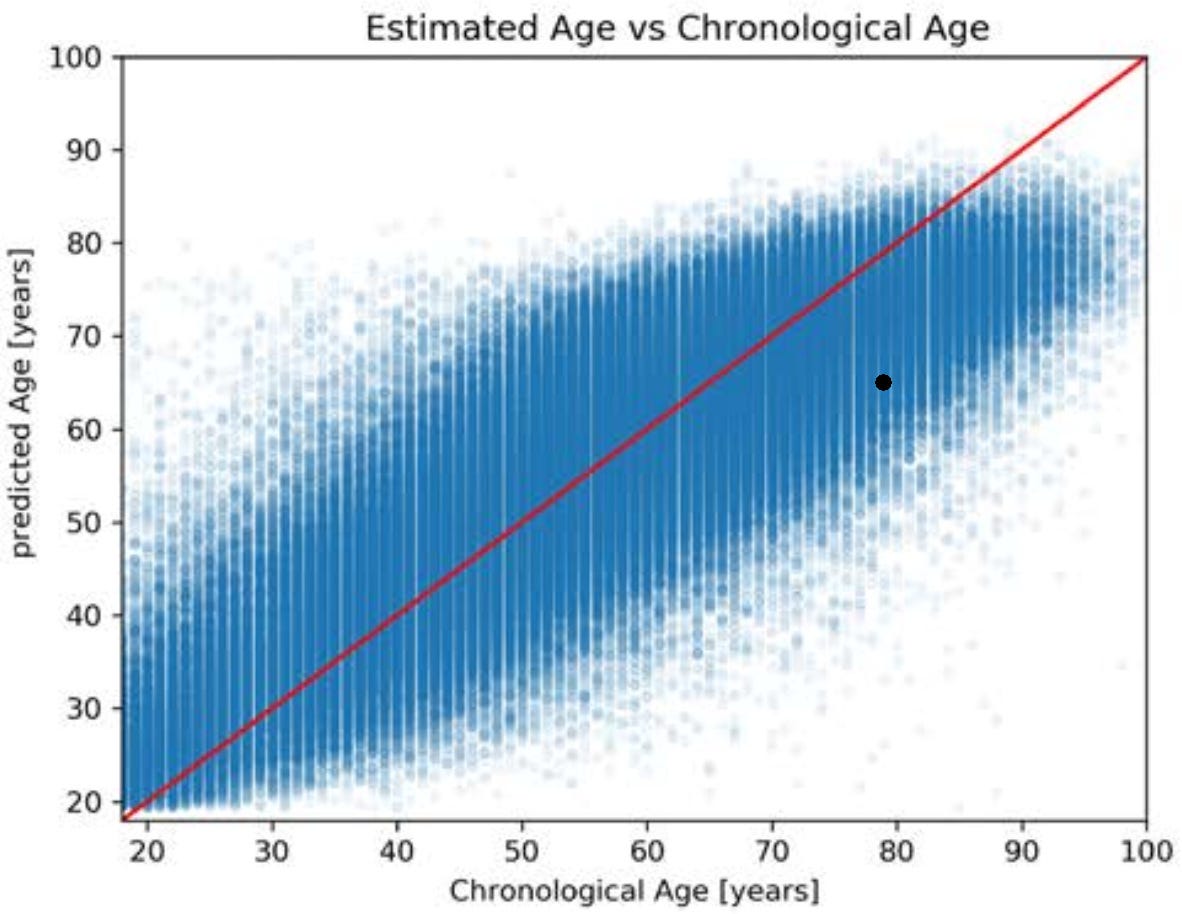
Trump's result sounds impressive, but as the image below shows 8, the AI system awards a 65 year old cardiac age to a substantial fraction of 79 year olds (indicated by the black dot). In fact, it looks like the average cardiac age given to 79 year olds is about 69 — 10 years younger than Trump's age at the time of the test. Clearly, the AI system is less accurate in older patients, and this alone should give pause about attaching a meaning to Trump's AI-EKG-age result.
Trump's AI-EKG-age result is 100% useless
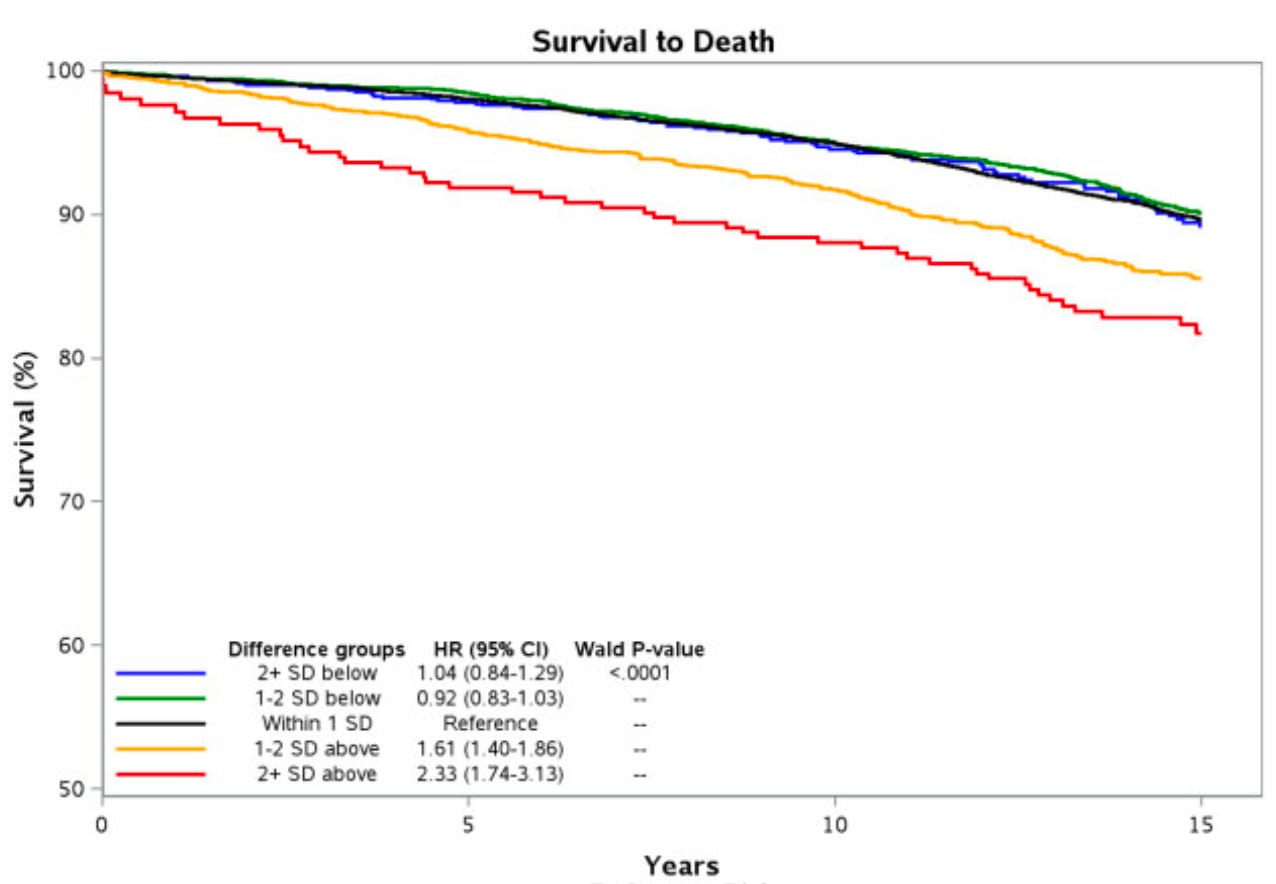
The AI-estimated age for Trump's heart has no firm medical significance. In other words, it may sound significant to say that his heart has similarities to a 65 year old's, but there is no evidence to suggest that the similarities make any difference in how the heart will behave over time in the real world. The Mayo AI-EKG-age subsystem was trained by feeding it hundreds of thousands of electrocardiograms where the age of the patient was known. That's all there was. The system got no data on how long the patients lived afterwards and it didn't know how sick the patients were at the time of the electrocardiogram. So it's a pretty blind system, and that's the first reason it's useless. The Mayo team performed a later study in much younger patients than Trump (average age 54) and found that an AI-estimated age younger than the chronological age conferred no survival benefit when compared against patients who had an AI-estimated-age close to their chronological age 7.
The AI-EKG-age suggests Trump has amyloidosis (Speculation #1)
With apologies, this is a rather complicated bit of speculative reasoning, written only secondarily for laypersons, most of whom will probably want to skip it.Therefore, if this is all true, then the lower AI-estimated-age for Trump is exactly what would be expected if he had cardiac amyloidosis. The lower AI-estimated age is actually evidence for Trump having cardiac amyloidosis. I wouldn't take this conclusion to the bank, but I think at this point the onus is on the Mayo people to prove that amyloidosis does not cause a systematic error in their AI-EKG-age subsystem.
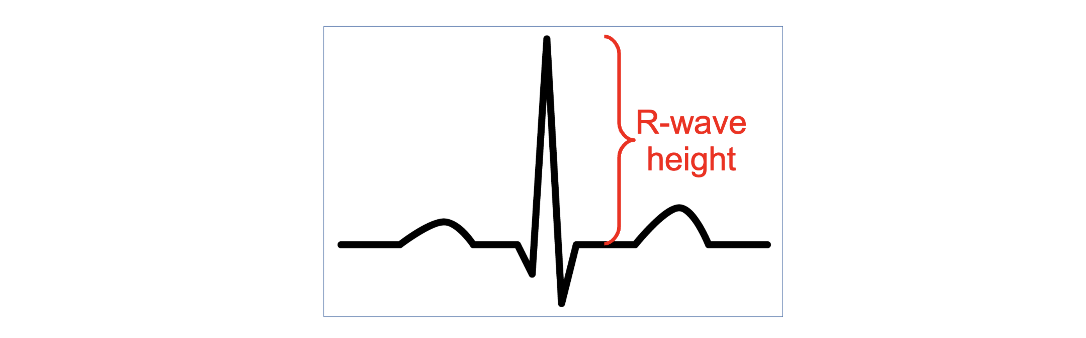
- There has been little published research on how readings from the standard electrocardiogram (the kind that was invented in 1911) change with age. It has been noted that the "R-wave height" increases with age 9.
- Longstanding hypertension increases the height of R-waves.
- The builders of the Mayo AI-EKG-age subsystem identified hypertension as a factor causing their software to label a person's cardiac age as older than their chronological age 8.
- From all the above, it is reasonable to conclude that taller R-waves is a significant factor in leading the AI-EKG-age subsystem to label a heart as old. Conversely, but equivalently, shorter R-waves will lead the software to label a heart as young.
- The AI-EKG-age subsystem was trained on a group of 775,000 patients 7 in whom approximately half had hypertension 8a 10a. These patients may be expected to have a higher than normal R-wave height, and there will be more of them among older patients in the training group. Reasonably, this would lead the software to strongly associate tall R-waves with older hearts.
- Lower-than-normal R-wave height is an electrocardiographic hallmark of cardiac amyloidosis 11, which tends to be a disease of older people.
- From 2000 to 2019 the Mayo Clinic saw only 2541 patients with cardiac amyloidosis 12. So even if every one of those cases has been used to train AI-EKG-age (an impossibility), that would only be 0.3% of the training group. This small percentage of short R-waves in old hearts in the training cases is going to be swamped by the very large percentage of training cases with tall R-waves in older hearts.
- Thus, the sofware will probably read short R-waves as an indicator of young age, so that amyloidosis patients are consistently rated as having younger hearts than their chronological age.
The AI-EKG-age suggests Trump has amyloidosis (Speculation #2)
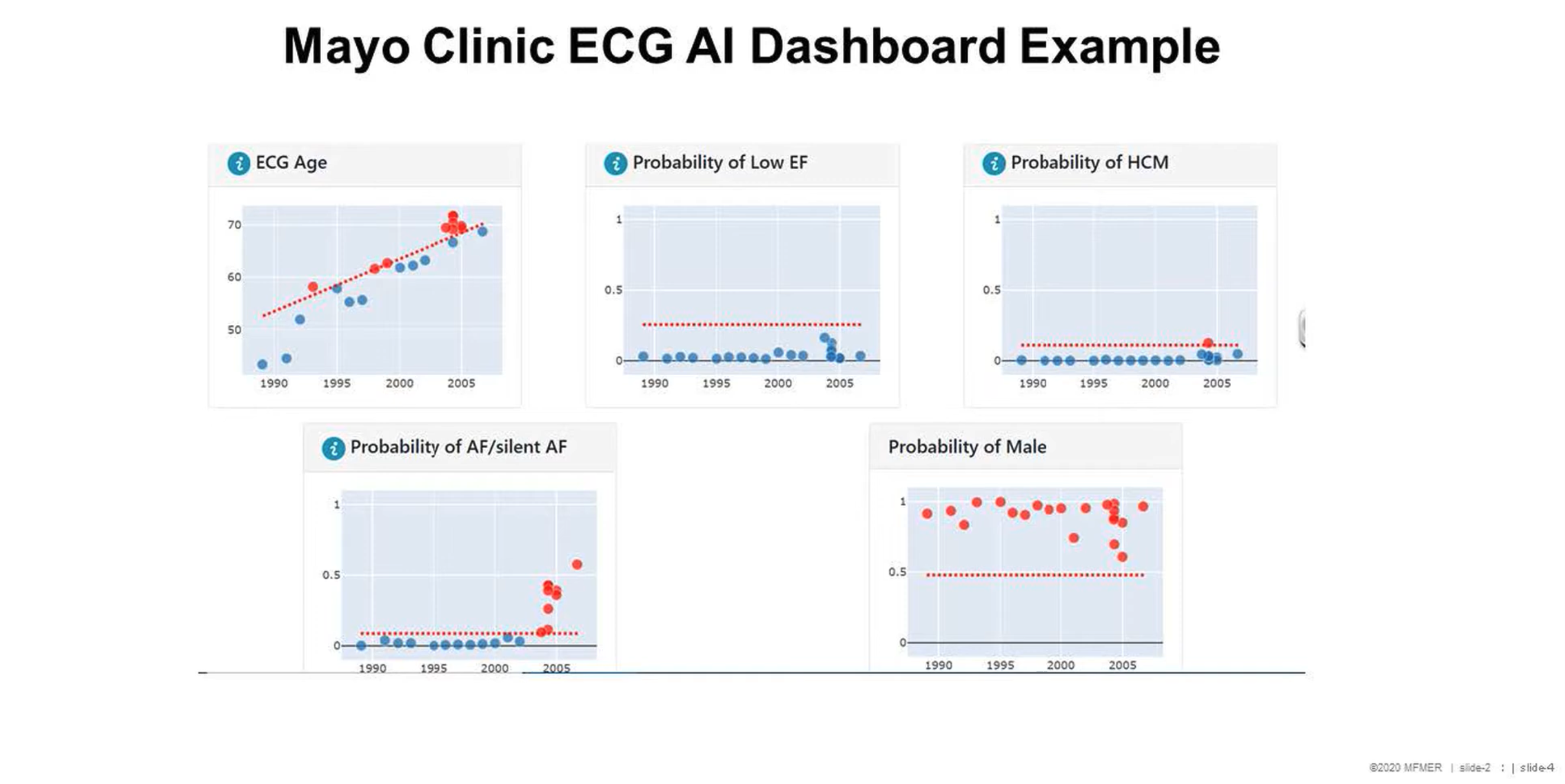
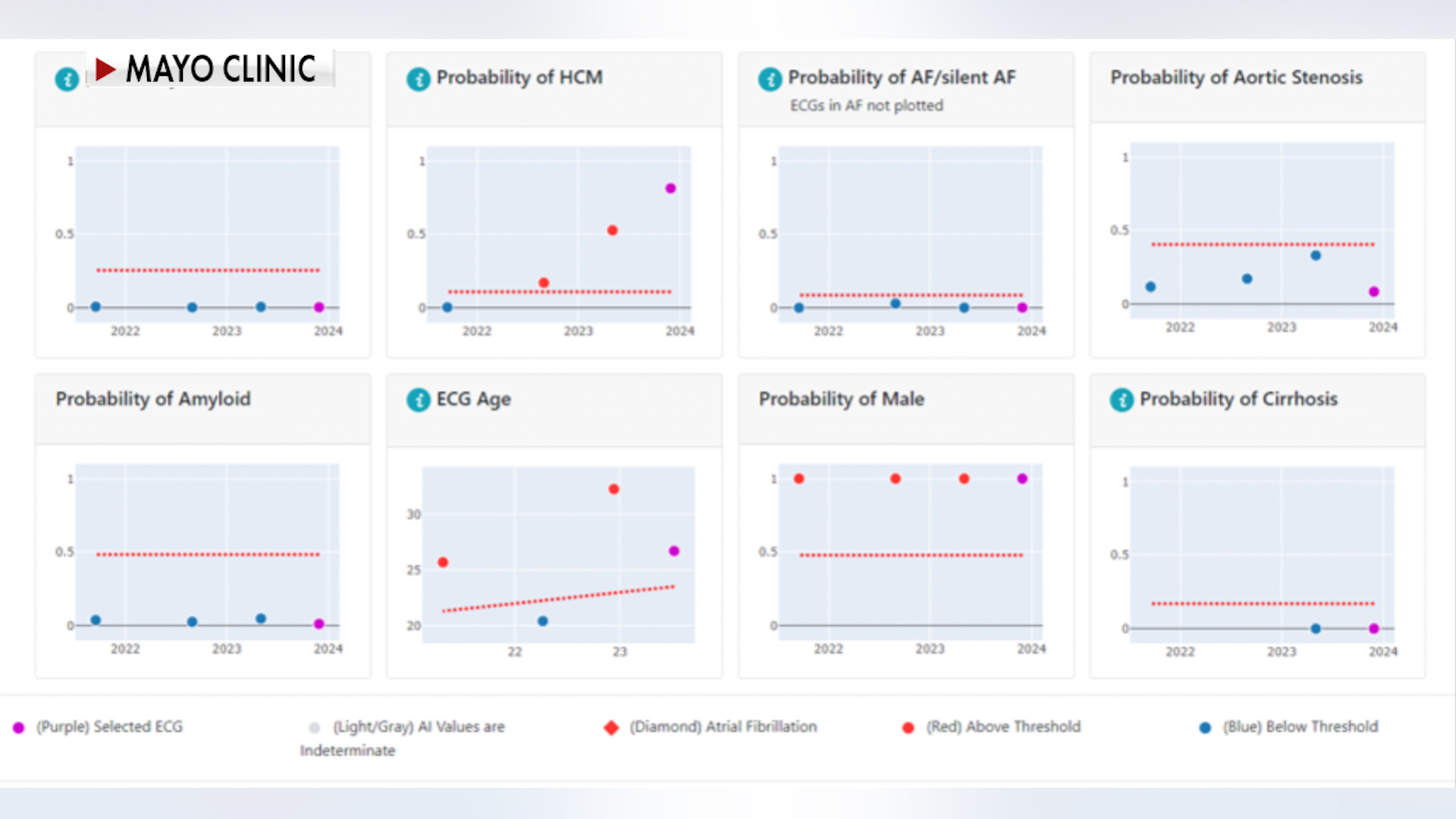
The AI-EKG is available only from the Mayo Clinic because it is still experimental. So why in the world would the White House go to the trouble of asking for the test? A potential answer, as hypothesized earlier, is that the Mayo AI-EKG system has six (or more) subsystems, and that the president's physician was interested in other subsystems more than the AI-EKG-age subsystem. This multiplicity of subsystems is easily seen in a snapshot of the Mayo "AI-EKG dashboard" that collects results from the multiple subsystems.
Why the AI-EKG-amyloid could be so helpful
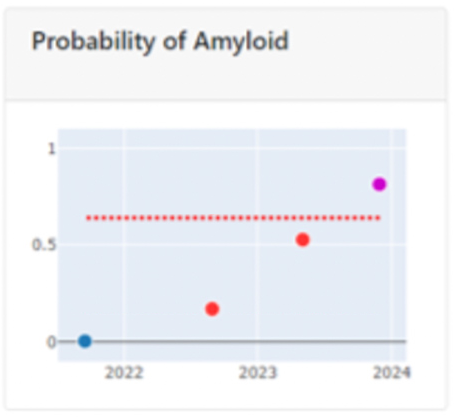
The AI-EKG-amyloid system could be extremely useful in Trump's case. The White House has Trump's standard EKGs on file back to 2018 (if not earlier) so they could have fed them all at once to Mayo, which could then plot how the probability of amyloidosis changed over the years, as in the made-up example below.
Conclusion
From a public relations standpoint, the AI-EKG-age brought multiple benefits. It enabled suppression of whatever abnormalities were on the standard 12-lead EKG and it helped paint a rosy picture of Trump's cardiac health, regardless of its actual state. If the White House came clean about the circumstances related to the AI-EKG, perhaps an innocent truth behind all this would be disclosed, but based on the information that is public now, and the information in the scientific literature (which I cannot claimed to have scrutinized to the maximum possible degree), I can think of no reason to include the AI-EKG-age in Trump's medical reports other than public relations. Such a conclusion has several weaknesses. My reconstruction of these motivations is necessarily subjective. Various areas on this page are marked as speculation. And perhaps I have missed a reference or two from the literature or have been too narrow in clinical reasoning. If so, please let me know and I will correct and apologize. But there is much here that is on firm ground, enough to warrant a "decoy" hypothesis. Finally, there is the co-existence of the AI-EKG-amyloid with the AI-EKG-age at the Mayo Clinic. The coincidence is absolutely arresting. It equals the famous coincidence in the movie Casablanca: "Of all the gin joints, in all the towns, in all the world, she walks into mine." But here, of all the experimental, unapproved diagnostic tests being developed in all of medical science, in all the world, Trump's EKG walks into the Mayo Clinic's AI-EKG joint, where testing for amyloidosis is the specialty of the house. The fundamental things apply.
Cited Sources
- Linskey A, Dawsey J, McGraw M. As Signs of Aging Emerge, Trump Responds With Defiance. Wall Street Journal. Jan. 1, 2026. Available on the web at: https://www.wsj.com/us-news/as-signs-of-aging-emerge-trump-responds-with-defiance-769c5dcd
- Grogan, Martha. Artificial Intelligence-Enhanced Electrocardiogram for Early Detection of Cardiac Amyloidosis. (Published Nov. 1, 2021. Downloaded on 2026-09-11.) Available on the web: https://www.mayoclinicproceedings.org/do-content/artificial-intelligence-enhanced-electrocardiogram-early-detection-cardiac-amyloidosis
- Hayes, Mills. Doctors say AI is a "game-changer" for number 1 killer of Americans. (Published Dec. 9, 2023. Downloaded on 2026-09-11.) Available on the web: https://www.foxbusiness.com/healthcare/doctors-say-ai-game-changer-number-1-killer-americans
Comment: The image is at: https://static.foxbusiness.com/foxbusiness.com/content/uploads/2023/12/mayp2.jpg - Malloy, Terri. Spotlight on early detection of 3 heart diseases using ECG-AI. (Published Feb. 22, 2024. Downloaded on 2026-07-26.) Available on the web: https://newsnetwork.mayoclinic.org/discussion/spotlight-on-early-detection-of-3-heart-diseases-using-ecg-ai/
- Marriott, Henry J.L. Practical Electrocardiography (7th ed.). Baltimore: Williams and Wilkins, 1983. 496 pages.
- Constant, Jules. Learning Electrocardiography (3rd ed.). Boston: Little, Brown, 1987. 621 pages.
- Ladejobi AO, et al. The 12-lead electrocardiogram as a biomarker of biological age. European Heart Journal — Digital Health. 2021; 2: 379-389. Available on the web at: https://doi.org/10.1093/ehjdh/ztab043
- Attia ZI, et al. Age and Sex Estimation Using Artificial Intelligence From Standard 12-Lead ECGs. Circulation: Arrhythmia and Electrophysiology. 2019; 12:e007284. Available on the web at: https://doi.org/10.1161/CIRCEP.119.007284
a 56% of the test set had hypertension, so we are making the assumption that the training set had approximately the same make-up.
- Vicent L, Martínez-Sellés M. Electrocardiogeriatrics: ECG in advanced age. Journal of Electrocardiology. 2017; 50(5): 698-700. Available on the web at: http://dx.doi.org/10.1016/j.jelectrocard.2017.06.003
- Attia ZI, et al. Screening for cardiac contractile dysfunction using an artificial intelligence-enabled electrocardiogram. Nature Medicine. 2019; 25: 70-74. Available on the web at: https://doi.org/10.1038/s41591-018-0240-2
a This paper deals with a different training set than used for AI-EKG-age. However, it is from the same Mayo investigators that trained the AI-EKG-age subsystem. Some 47% of this training set had hypertension, showing that the Mayo training sets, in general, have a high prevalence of hypertension.
- Martini N, et al. Electrocardiographic features and rhythm disorders in cardiac amyloidosis. Trends in Cardiovascular Medicine. 2024; 34: 257-264. Available on the web at: https://doi.org/10.1016/j.tcm.2023.02.006
- Grogan M, et al. Artificial Intelligence-Enhanced Electrocardiogram for the Early Detection of Cardiac Amyloidosis. Mayo Clinic Proceedings. 2021; 96(11): 2768-2778. Pubmed: 34218880. Available on the web at: https://doi.org/10.1016/j.mayocp.2021.04.023
- Clintrials.gov. Artificial Intelligence Enhanced ECG to Detect Cardiac Amyloidosis. (Published Feb. 17, 2026. Downloaded on 2026-09-11.) Available on the web: https://clinicaltrials.gov/study/NCT05557162
George Washington · John Adams · Thomas Jefferson · James Madison · James Monroe · John Q. Adams · Andrew Jackson · Martin van Buren · William Harrison · John Tyler · James Polk · Zachary Taylor · Millard Fillmore · Franklin Pierce · James Buchanan · Abraham Lincoln · Andrew Johnson · Ulysses Grant · Rutherford Hayes · James Garfield · Chester Arthur · Grover Cleveland · Benjamin Harrison · Grover Cleveland · William McKinley · Theodore Roosevelt · William Taft · Woodrow Wilson · Warren Harding · Calvin Coolidge · Herbert Hoover · Franklin Roosevelt · Harry Truman · Dwight Eisenhower · John Kennedy · Lyndon Johnson · Richard Nixon · Gerald Ford · Jimmy Carter · Ronald Reagan · George Bush · William Clinton · George W. Bush · Barack Obama · Donald Trump.45 · Joseph Biden · Donald Trump.47