
47⬅ Donald Trump: Systemic Amyloidosis

Quicklinks







Matters before 2021 are covered on the
Trump.45 page.
Donald Trump's second term has been dominated by an obvious physical decline 1 that administration officials have steadfastly ignored, even as equally steadfast allies publicly fear for his health 2. At age 80, hard data in Trump's most recent medical report point to a disease called systemic amyloidosis:
Donald Trump's second term has been dominated by an obvious physical decline 1 that administration officials have steadfastly ignored, even as equally steadfast allies publicly fear for his health 2. At age 80, hard data in Trump's most recent medical report point to a disease called systemic amyloidosis:
- His blood pressure is 105/71, down 20 points (in the top number) from his lifelong excellent readings.
- His ankles are chronically and untreatably swollen ("edematous").
- His heart squeezes well, when seen on cardiac ultrasound.
More...
Introduction
The three suspicion-arousing data points listed above are simple and clear. So why is this website so extensive? What more needs to be said? Well, some readers will rightly be skeptical and will make counter-points such as:All of these lead up to the hyper-skeptic's wishful but inaccurate bottom line:
- "We know what the leg swelling is — it's just bad leg veins." MORE
- "We know what the bruising is — it's just aspirin and handshaking." MORE
- "There's not enough evidence to diagnose amyloidosis."
(True! But my point is just that Trump needs testing for it.)- "The man is 80 years old, so of course he doesn't look like he used to."
- "Some dude is medically picking on Trump."
(No, I do this with every president.)It takes verbiage to put these and other points to rest.
- "There's just no reason to test Trump for amyloidosis."
It also takes verbiage to communicate the additional features of Trump's medical status, such as his bruising, anemia, etc. Strictly speaking, this material does not prominently factor into the need to test for amyloidosis, but it does illustrate the pervasiveness of whatever is afflicting Trump and it shows what appears to be deliberate concealment of medical information that is material to the conduct of a presidency.Finally, if amyloidosis is ruled out by the definitive tests, then the clinical material collected here may assist others in identifying a cause for President Trump's ailments.Asides appear like this.
When to suspect: abridged version — "clues""
It helps to rework the three observations listed above into two broader statements:Now we can look in medical journals and see whether experts agree with the significance of these factors. We start with this expert advice:
- Trump's low blood pressure and generalized fluid retention point to heart failure;
- Amyloidosis is the most likely cause of his heart failure because he has no history of hypertension, plus his echo shows good cardiac squeeze, plus his parents lived long.
A number of important clinical clues to the presence of [cardiac amyloidosis] have been described. One clue is a "natural cure" of hypertension: the need for down-titration or discontinuation of antihypertensive therapy. 3This expert "clue" is equivalent to our observation that Trump's blood pressure has recently dropped. Trump never had hypertension, but almost everyone in the amyloidosis age bracket does, so the essential point is that the patient's blood pressure is now lower than it has been... and Trump fits that. This is a powerful clue, because hypertension does not naturally cure itself. In other words, it is very unusual to see someone's blood pressure drop without some externally visible cause, such as weight loss, diet change, pill-taking, exercise, etc. Next:The signs and symptoms that should raise suspicion of [cardiac amyloidosis] include a history of right-sided heart failure; heart failure with preserved ejection fraction (especially in men); ... 4Trump fits this recommendation, too. The mention of "right-sided heart failure" refers to cases of heart failure where swelling of the limbs is prominent... as it is in Trump. The mention of heart failure with "preserved ejection fraction" means a failing heart that squeezes well... as it does in Trump. Thus, these two expert recommendations, alone, support a suspicion of amyloidosis in Donald Trump. The other two positive statements about him — no past hypertension, plus long-lived parents — ironically turn negative because they further strengthen the suspicion of amyloidosis, as we'll see below. More simply, if your 80-year-old father had these findings, you'd want him tested for amyloidosis. There is not one sign that President Trump has been tested for amyloidosis.
When to suspect: unabridged version — "understanding"
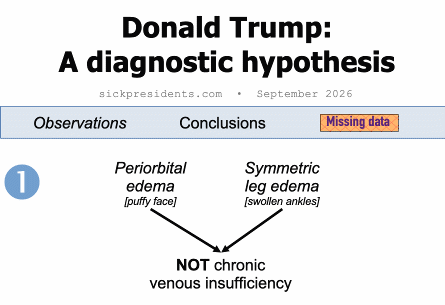
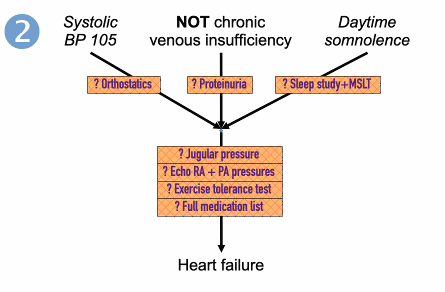
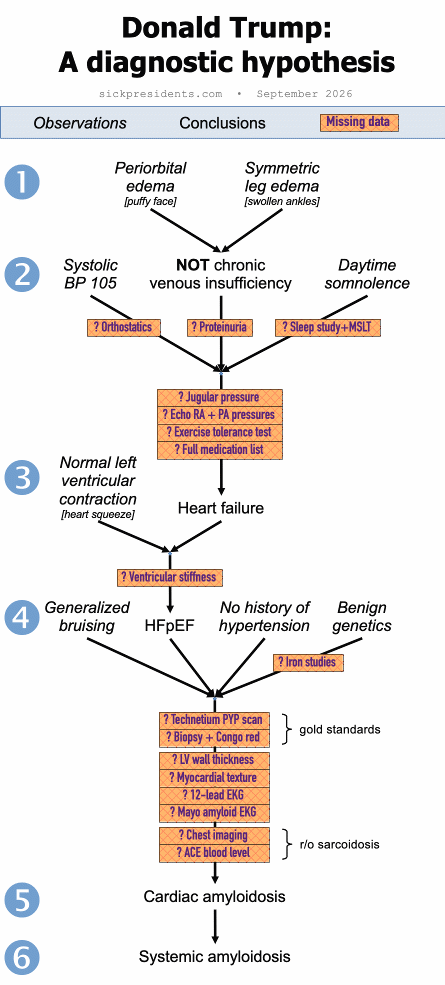
In the name of transparency, I admit that I arrived at the amyloidosis suspicion in President Trump not with the clues above, but with the combination of marked non-traumatic bruising and marked ankle swelling, which I remembered seeing for years in an amyloidosis patient. The possibility seemed incredible, so the next step was to look at the rest of Trump's clinical picture and see how that fit with the amyloidosis hypothesis. I was looking for an understanding of his physiology, to explain all of the other findings that review of his medical reports exposed.As part of this search, I was also looking for some fact that would veto the amyloidosis suspicion, but, as the rest of this website demonstrates, found none.So, below, I present my current understanding, diagrammed as a path of five steps like "If A and B, then C." It starts with simple observations, then concludes with a strong suspicion that Trump has cardiac amyloidosis, which equates to systemic amyloidosis. Just as importantly, the path shows how many times the president's physician could have demolished the amyloidosis suspicion, but omitted the test results that could do so. After presenting the path, the page briefly notes that amyloidosis explains some non-cardiac observations about Trump, then engages in speculations about other possible manifestations.
Step 1
Step 2
Step 3
A cardiac ultrasound test tells the physician which type of heart failure is at work. In Trump's case, the ultrasound ("echocardiogram") was said to show that his heart squeezes normally. Thus, Trump has the HFpEF type of heart failure.
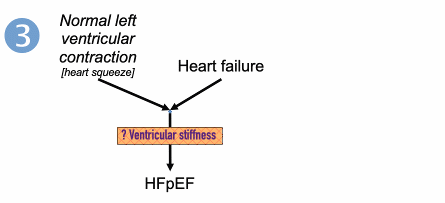
Step 4
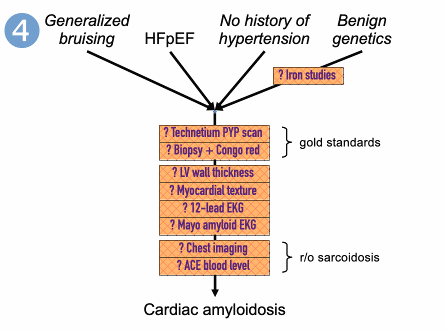
Step 5

Summary of all steps
In case you want to see all five steps at once, they are here:
· ACE = angiotensin converting enzyme
· BP = blood pressure
· EKG = electrocardiogram
· HFpEF = heart failure with preserved ejection fraction
· LV = left ventricle
· MSLT = multiple sleep latency test
· PA = pulmonary artery
· PYP = pyrophosphate
· RA = right atrium
· r/o = rule out
Trump's amyloidosis outside the heart
Amyloidosis explains observations about Trump outside of his heart. This is why it's called "systemic amyloidosis."
- His chronic bruising MORE Bruising is a hallmark of systemic amyloidosis, caused by amyloid proteins infiltrating the walls of small blood vessels. This makes them stiff and fragile, prone to breakage and bleeding with minor trauma — or sometimes no trauma at all. Trump has noticed this, and it may be a component of his fragile skin that is susceptible to cuts MORE. Less often, amyloidosis patients will become prone to bleeding because of abnormalities in their blood clotting
- His chronic anemia MORE Patients with amyloidosis may develop anemia for a variety of reasons, and this holds true for Trump, even if he does not have amyloidosis. See the anemia page for deeper discussion.
- His chronic sleepiness MORE The source of this problem would be in the heart, but most people do not think of sleepiness as a heart problem, so it is listed here as "outside the heart." Poor sleep can mimic a vast array of psychological conditions.
- His healthcare utilization — 22 consultants Presidents see lots of physicians during their physical. Trump set a record of 22 in May 2026 MORE, compared to 14 in April 2025 MORE, and 12 in 2019 MORE (unclear if all of these were physicians). Joseph Biden saw 13 in 2021, 11 in 2023, and 11 in 2024 (never a urologist, alas). It does not take 22 physicians to tell someone they are well.
I once had an astronaut physical and saw six physicians (internist, ophthalmologist, cardiologist, psychiatrist, gastroenterologist, otolaryngologist), plus a dentist and a rather cheesed-off psychologist. No doubt, a pulmonologist, nephrologist, radiologist, endocrinologist, and hematologist looked at test results behind the scenes. That makes 13, including 11 physicians.Part of the reason for 22 may be Trump's age. Another reason, however, may be the systemic effects of amyloidosis, which can affect most, if not all, organs in the body, each of which has a specialist attached in modern American medicine.- His healthcare utilization — missing test results It is insane to realize that the most important man in the world, in the richest nation in the world, with the most advanced healthcare in the world, underwent a physical examination that did not include a urinalysis, a chest x-ray, or a standard electrocardiogram, and his doctors missed the fact that he is anemic, sleepy, and bruised all over. Yet, if you read Trump's 2026 medical report, that is exactly what happened. No one should believe it. Children going to soccer camp get a urinalysis and an EKG. All those tests and all those problems were evaluated. But something in the results is too private to be released publicly.
Speculations
Some puzzling observations about Donald Trump could make sense if they were part of an amyloidosis illness. The evidence here is limited, so these possibilities qualify only as "speculations."
- He may have a surgical scar on his right wrist resulting from carpal tunnel surgery MORE
- His tentative gait, especially going down stairs, could be due to amyloid peripheral neuropathy in his feet. At the other extreme of concern, it could be due to precariously fitted elevator shoes!
- His mystery test indications Trump underwent CT angiograms of the coronary and pulmonary arteries in 2025, and almost underwent a cardiac MRI. No specific reasons were given for this testing, but it is reasonable to believe that these tests were seeking to understand why he was having heart failure. I expect the physicians suspected amyloidosis before they began this search, but felt they had to pursue the possibility that a second problem could be afflicting Trump. Finding a second problem would be good news if it were treatable, because eliminating its contribution to Trump's decay would improve his medical state. Rejecting the cardiac MRI in this setting makes sense, because there is no point in confirming a poorly treatable disease, and it would have tipped off every cardiologist in the country that heart muscle disease was being considered as a possibility.
- As noted, amyloidosis can have psychological effects due to sleepiness and fatigue. Fatigue is different from sleepiness. It is interesting to remember Warren Harding's comment about the most prominent symptom in his own terminal heart disease: "I had no idea that a man could be so completely exhausted," and he played golf six days before he died! MORE Beyond that, it is simply impossible to point to a particular behavior in any amyloidosis patient and pin it on amyloidosis itself.
- Well, there is one psychological effect that can be pinned on amyloidosis: the appreciation of one's approaching mortality can change behavior. I leave it to readers to think about this.
- Radioactive zone I am not going to speculate on projected lifespan or on current governance.
Evasion speculations
Given what appears to be an adversarial approach to information disclosure by the presidential physician, I worry that the response to even a simple question like "What is the evidence the president does NOT have amyloidosis" could get engineered into a non-response. It is possible. I could deflect the calls by saying "These suspicions of amyloidosis are so unfounded that they need no reply. They're unfounded because the president's most recent blood pressure was 125/75, and here is a photo of his skinny ankles, and I can report to you that his intracardiac pressures were completely normal. So you can see that the data driving the suspicion of amyloidosis was misinterpreted, and there is no reason to test the president for amyloidosis." And they could that truthfully if:If you are a member of the press, make sure that these tricks are not pulled on you.
- They gave Trump vasoconstrictor medicines like midodrine, which raise blood pressure and are recommended when autonomic amyloidosis neuropathy is present 3;
- Trump wore compression stockings to shrink his ankle size;
- On a separate day, Trump underwent extremely aggressive diuresis to lower intracardiac pressures, perhaps at the cost of creating a blood pressure so low that he could not stand upright for a time, then, on top of that, had his intracardiac pressures measured while he was sitting up or tilted up, to lower them even more.
Of course, it is trivial to dissolve a suspicion of amyloidosis by lying and having the medical people fall on their sword. An unscrupulous person could say "In retrospect, one of President Trump's 22 consultants had started him on a medication that caused an unexpected drop in blood pressure that we noticed quickly, but not immediately. We apologize for our oversight and for the confusion it caused, and thank the public for bringing it to our attention." Or, "We erred by measuring the president's blood pressure too soon after he had been subjected to a demanding medical test." In both examples, questions would afterwards arise, but they would be questions about the doctors and nurses in the White House Medical Unit, not about the president's health — mission accomplished.
Apology: caveats on "definitive" nuclear-scan testing
Nothing in medicine is as simple as it first seems. But it is counter-productive to present the full complexity right off the bat because it only causes frustration and confusion. If you have endured this far, however, you deserve to know some of the additional details around the supposedly "definitive" nuclear scan for amyloidosis. The first is that the nuclear scan requires preliminary tests — a simple blood draw and urine collection — to ensure it will provide trustworthy results. MORE The second is that the nuclear scan is known to miss some cases of cardiac amyloidosis. There was no false advertising here, because no one should expect that any test in medicine is perfect. The sleazy part is what to do after a negative scan. Experts from the American College of Cardiology advise that "further investigation is warranted if the clinical suspicion is high" 5. In other words, if a physician is very suspicious of cardiac amyloidosis before the scan, and is surprised by a negative result from the scan, the physician should not accept the negative result without doing more work — the "further investigation." How does that leave us with Trump? I would say the following... If Trump's physician were to announce in one sentence that the nuclear scan was negative, then, given my current strong level of suspicion, I would say further investigation is warranted, and that Trump should have a cardiac biopsy (which is easy, safe, and painless). But if Trump's physician were to announce a negative scan along with negative results from the many omitted tests identified throughout this website, then I would accept the accuracy of the negative nuclear scan. That is because the raft of negative results from the omitted tests would lower my level of suspicion. Hence, the true sleaze is that my request for a simple read-out on the results from the nuclear test is really a request for more than that if the test is negative.
Summary
The master diagram on this page reinforces three main points:The master diagram has an important secondary purpose: to show the large amount of medical data that the White House has suppressed. I cannot be sure they have acquired all the data noted as missing, but I can be sure they have acquired most of it. Each item labelled as missing data has the potential to weaken (or strengthen) the amyloidosis suspicion, depending on its value. Finally, let's move to human considerations. A strict reading of Trump's most recent medical report offers no clue that the president's physician has even considered the possibility amyloidosis. If one accepts that, improbable as it may be, it becomes an ethical good to bring amyloidosis to the attention of the president and his physician so treatment can begin. That ethical good is magnified because of the limited effect of amyloidosis treatments. They do not reverse the disease. Thus, if he has amyloidosis, every day without treatment is another day of irreversible decline. Getting the president diagnosed and onto treatment as soon as possible is therefore imperative.
- (1) A clinical suspicion of amyloidosis is well-founded for President Trump.
- (2) Given the well-founded suspicion, a technetium PYP scan is indicated to rule out amyloidosis — or to rule it in.
- This assumes blood and urine tests for monoclonality are negative
- It also assumes no recent tissue is available for Congo red staining
- (3) The results of the technetium scan should be publicly disclosed.
Cited Sources
- Reiner, Jonathan. I Was Dick Cheney's Cardiologist. Trump Has Not Looked Well, and We Should Know Why. New York Times. Aug. 12, 2026. Available on the web at: https://www.nytimes.com/2026/08/12/opinion/trump-health-questions.html
- Chavez, Paloma. Bill O'Reilly Urges Trump, 80, to Take a Month Off for His Wellbeing: "You Need a Breather". People. July 23, 2026. Available on the web at: https://people.com/bill-oreilly-urges-trump-take-month-off-12025441
Comment: O'Reilly's comment is startling in its similarity to the Chicago Tribune's editorial of March 22, 1865, which said of a "worn and weakened" Abraham Lincoln: "He needs a least a month's entire rest from his official duties." (See The Physical Lincoln Complete, pp 105, 387-388.) Lincoln was then in the advanced stages of cancer, as discussed in The Physical Lincoln. - Ruberg FL, et al. Transthyretin Amyloid Cardiomyopathy JACC State-of-the-Art Review. Journal of the American College of Cardiology. 2019; 73: 2872-2891. Available on the web at: https://doi.org/10.1016/j.jacc.2019.04.003
- Nativi-Nicolau JN, et al. Screening for ATTR amyloidosis in the clinic: overlapping disorders, misdiagnosis, and multiorgan awareness. Heart Failure Reviews. 2022; 27: 785-793. Available on the web at: https://doi.org/10.1007/s10741-021-10080-2
- Kittleson MM, et al. 2023 ACC Expert Consensus Decision Pathway on Comprehensive Multidisciplinary Care for the Patient With Cardiac Amyloidosis. Journal of the American College of Cardiology. 2023; 81(11):1076-1126. Available on the web at: https://doi.org/10.1016/j.jacc.2022.11.022
George Washington · John Adams · Thomas Jefferson · James Madison · James Monroe · John Q. Adams · Andrew Jackson · Martin van Buren · William Harrison · John Tyler · James Polk · Zachary Taylor · Millard Fillmore · Franklin Pierce · James Buchanan · Abraham Lincoln · Andrew Johnson · Ulysses Grant · Rutherford Hayes · James Garfield · Chester Arthur · Grover Cleveland · Benjamin Harrison · Grover Cleveland · William McKinley · Theodore Roosevelt · William Taft · Woodrow Wilson · Warren Harding · Calvin Coolidge · Herbert Hoover · Franklin Roosevelt · Harry Truman · Dwight Eisenhower · John Kennedy · Lyndon Johnson · Richard Nixon · Gerald Ford · Jimmy Carter · Ronald Reagan · George Bush · William Clinton · George W. Bush · Barack Obama · Donald Trump.45 · Joseph Biden · Donald Trump.47