
47⬅ Donald Trump: Heart Failure

Quicklinks



Swelling ("edema") of Trump's ankles began in July 2024 or earlier, but his
physician and the White House did not mention the problem until spurred by
press photographs a year later.
They have never acknowledged the facial swelling ("peri-orbital edema") that
also appeared in mid-2024, and have consistently low-balled the amount of ankle
swelling.
MORE
The presidential physician's diagnosis of "chronic venous insufficiency," offered
in July 2025 and never revised, does not explain the facial swelling or the
rapid worsening of the ankle swelling from February to April 2025.
Heart failure and nephrotic syndrome are better explanations for Trump's fluid
accumulation.
SEE BELOW
The substantial accumulation of fluid in the ankles and legs complicates the
assessment of Trump's weight.
Despite his 13-pound increase in total weight from 2025 to 2026, his dry
weight appears to be relatively constant, meaning that he did not put on fat or
muscle, but he gained fluid.
MORE

In July 2025, the president's physician reported that he found no signs of heart
failure in the president
MORE.
He was driven to make this statement because
widely circulating photographs had recently showed marked swelling of Trump's ankles
MORE
and because swollen ankles ("edema") are a key sign of heart failure.
There are problems with his statement
SEE BELOW:
- Inadequate in multiple ways
- Delayed
- Date uncertain
- Not reiterated in May 2026
- Limited and misinterpreted evidence to support the claim
- Missing evidence that could refute the claim
- The proffered diagnosis is not tenable
- Ignored strong evidence for heart failure
- Limited, but direct evidence of heart failure symptoms

Deliberately ignored by the president's medical reports and denied by the White House,
but widely reported in the media, Trump has difficulty staying awake when
he is not talking
MORE. Videos show him drifting into short sleeps
at the NBA playoffs, Pope Francis's funeral, Cabinet meetings, and multiple
Oval Office occasions.
Although Trump has long had many reasons to sleep poorly at night,
the major threat to
sleeping that has emerged since his first term in office is heart failure
SEE BELOW, suggesting that his daytime
drowsiness is a manifestation of cardiac amyloidosis. If heart failure is
making it difficult for him to sleep at night, that could also explain his
late-night social media posting.
More...
This page analyzes the problems with the presidential physician's July 2025
claim that Trump does not have heart failure
MORE.
It concludes that
Trump does have heart failure of mild to moderate degree. He does not have
severe heart failure (as of September 2026).
The analysis is divided into these sections:
- A Bit About Heart Failure
- Physician's Claim (of no heart failure) is Inadequate in Multiple Ways
- Claim Ignores Strong Evidence of Heart Failure
- Claim Ignores Limited Evidence of Heart Failure Symptoms
- Miscellaneous Points
A Bit About Heart Failure
Heart failure is a common and serious disorder with profound effects. It causes swollen legs, fatigue, breathlessness, reduced exercise tolerance, and shortens life. Some types will respond well to treatment. Others, such as amyloidosis, usually don't. Fundamentally, the heart's "failure" is being unable to pump enough blood to meet the body's needs. This first becomes apparent during physical exertion, since blood/oxygen demands go up during exertion. In advanced stages a person can be short of breath while sitting in a chair. Heart failure is a serious complication of systemic amyloidosis. To a large degree, the suspicion of amyloidosis hinges on the presence of heart failure, and it is here that I expect the White House to stake there resistance to publicly acknowledging the possibility that Trump has amyloidosis.
Physician's Claim is Inadequate in Multiple Ways
- Timing — delayed
Trump's ankles began swelling even before he began his second term in January 2025 MORE. He had a supposedly complete physical in April 2025 MORE, but no comment was made about his ankles. Only in July 2025 did the White House acknowledge the swelling MORE — six months after the president took office. The July report also made the dubious claim that Trump noted the swelling "in recent weeks." Photos show his grossly swollen ankles as far back as July 2024. MORE
- Timing — date uncertain
Standard phrasing in presidential medical reports states the date on which the president was examined MORE MORE. In the report of July 2025, no such date is given MORE. Instead, the report vaguely relates that "this concern was thoroughly evaluated by the White House Medical Unit" and that "The President underwent a comprehensive physical examination." Nowhere does it state when the president was evaluated. The ambiguous date is important because, when the physician reports that "no signs of heart failure, renal impairment, or systemic illness were identified," that statement applies only to a slice of time. Things change. Anyone trying to conceal heart failure could, by this technique, wind the clock backwards to a time before such signs appeared and still make a truthful, if misleading, statement that no signs were present. Ambiguity is a hallmark of this presidential physician's reports MORE.
- Timing — not reiterated in May 2026
If Trump had no detectable signs of heart failure in July 2025 or some time earlier, why did the presidential physician not make the same statement in his May 2026 report? Trump's legs continued to show marked swelling, so the question of heart failure was still relevant — all medical diagnoses must continue to be questioned over time... because things change. It is noteworthy, too, that the May 2026 report does not reiterate the diagnosis made in July 2025 (chronic venous insufficiency).
- Limited evidence for the no-heart-failure claim
By a strict reading, Trump's July 2025 evaluation acquired only two pieces of evidence that could specifically rule out heart failure: the echocardiogram (cardiac ultrasound) and the amount of "B-type natriuretic peptide" in the blood. Here are the problems. First, the echo results were described without detail and interpreted without nuance, saying only that "normal structure and function" were observed. This is inadequate because (a) the echocardiogram was obtained with the patient lying on a table and some types of heart failure become apparent only when the heart speeds up or the patient is exerting themself, (b) there was no mention of "pressures" within the heart, which are a key indicator of heart failure, and (c) some types of heart failure can occur with a normal echocardiogram if one looks only at "structure and function," with "function" referring, as it typically does, only to the heart's ability to squeeze. Heart failure due to cardiac amyloidosis satisfies the (a), (b), and (c) criteria. Second, the July 2025 report was sloppy in its reporting of the B-type natriuretic peptide, which is a broad term (blood contains several such peptides). We will assume it was referring to NT-proBNP and we will also assume what the report does not actually say: that the blood level was normal. Even if these assumptions are correct, there is still a major problem: when the patient is obese and has a normal echo, as with Trump, a normal NT-probBNP level does not rule out heart failure, as discussed in the next bullet item. It is, therefore, apparent that the two data elements that could rule out heart failure are inadequate to do so. In addition, there are many other data elements that could rule out heart failure and they were not obtained (or just not reported). These are discussed below.
- Misinterpreted evidence for the no-heart-failure claim — NT-proBNP
NT-proBNP is a normal protein found in the blood. In persons with heart failure, the level of NT-proBNP rises to abnormally high levels. During his May 2026 exam, the amount of NT-proBNP in Trump's blood was normal. This would ordinarily rule out the possibility of significant heart failure. However, obese patients with heart failure may not show a rise in NT-proBNP 1. Trump is obese (or nearly so). Similarly, heart failure patients in whom the heart squeezes well ("preserved ejection fraction") may also not show a rise in NT-proBNP 2. Trump has a preserved ejection fraction. Thus, Trump's normal NT-proBNP value is useless in saying he is free of heart failure.
There is a caveat to this statement. Once heart failure becomes severe, the NT-proBNP will be high in all heart failure patients. So we can be sure that, as of July 2025, Trump does not have severe heart failure, leaving mild and moderate heart failure as possibilities.An additional minor point: Here I have used the correct name "NT-proBNP." Trump's May 2026 medical report uses an incorrect name: proBNP. This is a screw-up because proBNP is a separate chemical found in the blood. An entire family of BNP proteins circulates in the blood, and keeping them straight requires understanding. NT-proBNP is commonly measured and proBNP is rarely measured. Only by looking at the normal range for the report's "proBNP" level did it become clear that NT-proBNP was being measured for Trump.Missing evidence that could refute no-heart-failure claim (#1)Group 1
The easiest way to refute the possibility of heart failure is to put the patient on a treadmill and see what happens during exercise. The question it answers: How quickly does the patient get breathless? This does not mean that an exercise test is necessary to diagnose heart failure, but for a patient in whom the diagnosis is being entertained, and who is not constrained by worries about medical expense, an exercise test is superb not only for diagnosis, but to follow the response to treatment. Its key benefit is that, unlike all other heart failure assessments, it acquires data when the patient is exerting themself, getting to the core of their symptoms.Group 2
Nevertheless, assessments performed with the patient at rest are powerful methods to refute the diagnosis of heart failure, because each one makes it harder for the disease to lurk undetected:- Blood pressures inside the heart / doppler echocardiogram
- Jugular venous pressure on physical exam
- Chest X-ray or Chest CT
- Standard electrocardiogram
Group 3
Another serious lapse is the demonstrated concealment of the Trump's full list of medications MORE. There are medications that can cause leg swelling (not usually to this extent), and there are uncommonly-used medications that can cause heart failure. More importantly, a complete medication list that did not include medications to treat heart failure would be convincing evidence that Trump's physicians did not think he had heart failure.Group 4
Finally, there is clear evidence that important information is missing: why did Trump undergo CT angiography of both the pulmonary arteries and the coronary arteries later in 2025? These are not routine tests, and they carry non-zero risks of allergic shock and kidney damage, so there must have been something that prompted his physicians to perform the tests. Physicians also considered a cardiac MRI, which is a decidedly exotic test... that is especially useful when cardiac amyloidosis is suspected.Proffered diagnosis is not tenableIn July 2025 Trump's physician reported, untenably, that a condition called "chronic venous insufficiency" was causing Trump's legs to swell. Another page refutes that diagnosis by showing its many contradictions MORE. Even Trump's own doctors appeared to have worried about the inadequacy of the venous diagnosis. Returning to the question of why Trump had coronary angiography, pulmonary angiography, and almost a cardiac MRI, his physician said they were "to definitively rule out any cardiovascular issues" 3... which sounds like they are casting about for a diagnosis to explain something or are just being shut-mouth.
One more thing: Kidney disease is not ruled outThe July 2025 report said no signs of "kidney impairment" were found MORE. Surprising as it may be, this is not the same as saying the kidneys are normal, because "kidney impariment" is a term of art 4. Saying "no signs of kidney impairment" does not rule out nephrotic syndrome.
In other words... Kidneys have more than one job. Their primary job is removing waste products from the blood and putting them into urine. The phrase "no kidney impairment" applies to this first job only 4, meaning that the kidney is properly disposing of the body's waste products. The phrase does not cover one of the kidney's other essential jobs. The flip side of excreting waste products into urine is keeping valuable products in the blood. Specifically, normal kidneys keep proteins in the blood and do not let them go into into urine. Unfortunately, there are conditions where sick kidneys allow protein into the urine, producing a condition called "nephrotic syndrome." In attempting to compensate for the lost protein, the body retains fluid... in a potentially big way.One of the peculiar properties of fluid retention in nephrotic syndrome is that it occurs throughout the body, unlike fluid retention in heart failure, which more strictly follows gravity downward. This makes Trump's puffy face a clue that he might have nephrotic syndrome. One of the first noticeable signs of systemic amyloidosis is protein in the urine, followed later by the full-on nephrotic syndrome with fluid retention, both arising from amyloid proteins infiltrating the kidney and interfering with the protein-retention function without harming the waste-excretion function. Persons with amyloidosis can (and do) have both nephrotic syndrome and heart failure, which leads to marked fluid retention. Comment: The president's physician is an emergency room doctor, so it is possible he was simply misusing the term "renal impairment" because he was thinking in the language of bureaucrats instead of the the language of nephrologists. Or maybe he wasn't; he no doubt consulted nephrologists. The nephrologists do not like the term "kidney impairment" and for years have urged people to stop using it 4. Bottom line: no one can tell what the president's physician was thinking here (and maybe that's what he wants). It is not certain that kidney disease is ruled out.Claim Ignores Strong Evidence of Heart Failure
This section is going to be hard to believe because it is so simple and so ironic. Although there is considerable objective evidence that Donald Trump and his physician have labored to produce benign medical reports about Trump, this section shows that they released far more information than they intended, and that it paints a 180-degree opposite picture. It comes down to Trump's blood pressure history, which strongly suggests he has heart failure.
Low blood pressure
Here are the blood pressure readings from Trump's past White House medical reports, graphed: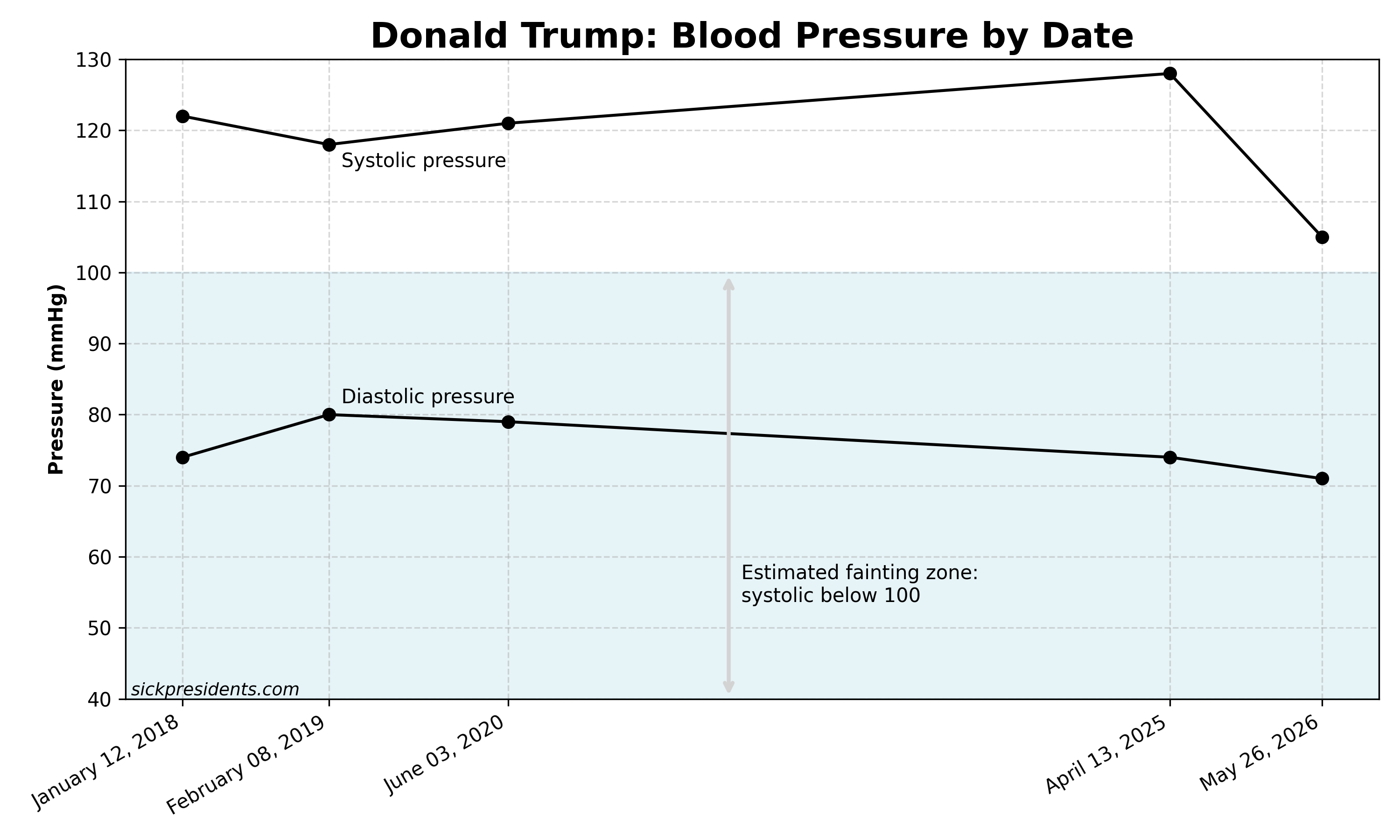
- Although 105/71 is gloriously suggestive of a marathon runner's physiology, the president is not a marathoner. He is a sedentary, overweight, fluid-retaining, elderly man fond of salty fast food — all reasons his blood pressure should be higher. Given all that, so low a blood pressure means something is amiss.
- And it is newly amiss: his systolic blood pressure, 105, is 20 points lower than his previously stable 2018-2025 baseline.
-
His new blood pressure is concerningly low for an 80 year old. Older people often need a higher pressure to push blood through not-young arteries into the brain. A systolic of 105 is low enough to risk light-headedness, fainting, and falling. His doctors would permit a 105 pressure only if forcing a higher pressure was impossible or was more dangerous than the catastrophic risk of toppling down the tall, hard air stairs of Air Force One. (Photo credit below.)
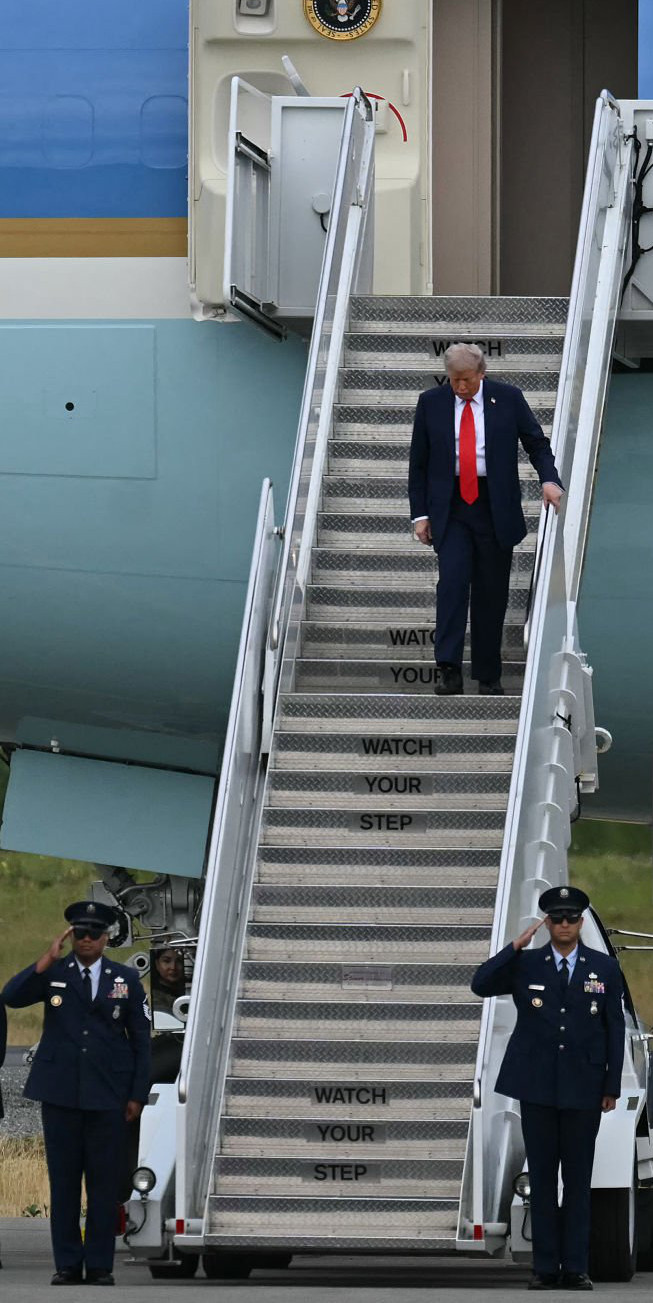
- The falling risk also makes it unlikely that Trump's physicians would report a fluke reading of low pressure. In fact, just the opposite: 105 is probably a good day.
Increased heart rate
Heart rate is a squishy data point, because it can vary so much, and so quickly, especially if measured in casual circumstances rather than the formal way. But if we assume that a president deserves a formal assessment, then the heart rate has the potential to be informative, and, in Trump's case, it is. The graph below is the same as the earlier blood pressure graph, except Trump's heart rate has been plotted in the bottom line instead of plotting the bottom-blood-pressure-number. This graph shows that the weakening of his blood pressure is accompanied by a speed-up in his resting heart rate.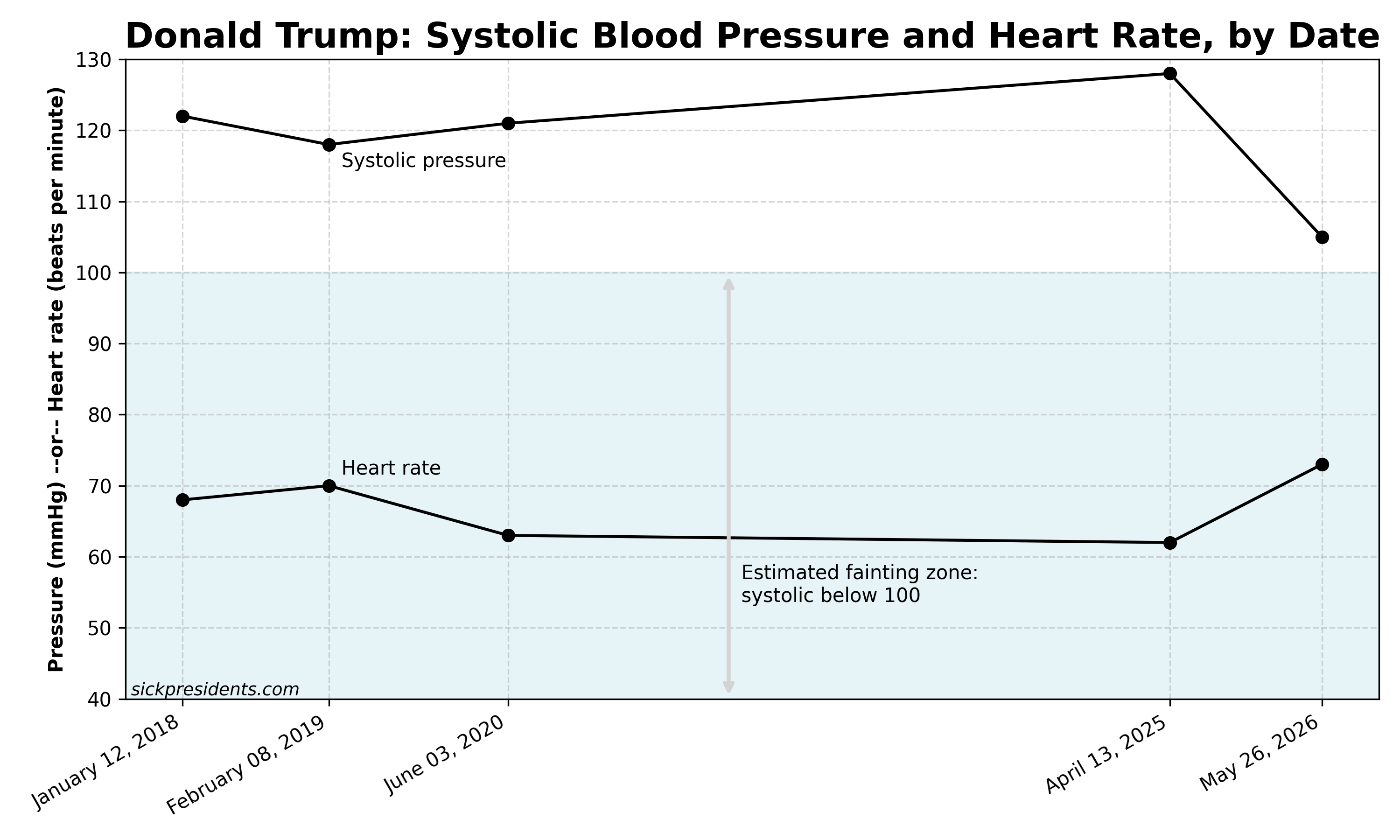
Cause of Trump's presumed heart failure
If it is surprising that the release of seemingly normal medical results can lead to the diagnosis of a serious disease, it is even more suprising that additional normal results can reveal the reason why Trump might have heart failure at all. Consider:- Trump's heart squeezes normally (as seen on cardiac ultrasound)
- Trump has no past history of high blood pressure (hypertension)
- Trump has no family history of genetic disease (especially hemochromatosis)
Summary
This is a powerful analysis, but it has not been a complicated analysis. And it uses information straight from the White House medical reports. Comment: The media's medical reporters could have made this analysis the day Trump's latest medical report appeared in May 2026. Where have they been?Claim Ignores Limited Evidence of Heart Failure Symptoms
Given the strong evidence in the section above, this section is icing on the cake as far as diagnosis goes.
Breathlessness
Unexplained breathlessness has been captured twice on videos of Trump in 2025-2026. It is important to know that breathlessness in heart failure can come and go from hour to hour or day to day. Salt intake, fluid intake, medication delays, heart rhythm disturbances, and other factors that vary over minutes, hours, or days can cause episodic breathlessness if the heart is compromised. So, just because a breathlessness episode is followed by days or weeks of easy breathing, the occurrence of past breathlessness retains its full import.
June 24, 2026: Breathless while speaking, after what appears to be a short walk on level ground.- Video here: https://x.com/atrupar/status/2069830849462157342
- Video here: https://www.facebook.com/CBSNews/videos/president-trump-arrived-at-the-us-capitol-for-a-closed-door-meeting-with-republi/835044682808094/
Sep. 29, 2025: The press was astute in identifying breathlessness in this video.- Video here: https://www.thelist.com/1982164/trump-heavy-breathing-has-internet-worried-about-health/
- Video here: https://x.com/atrupar/status/1972730955145052612
- Both videos are the same. Breathlessness is most evident after Trump speaks for five uninterrupted seconds from 0:29 to 0:34. Afterwards, he speaks only a couple words at a time, and his exhalations are noticeably louder.
October 2020: Markedly and memorably short of breath returning to White House after covid hospitalization.- That is not being counted here as heart failure evidence.
- It is always possible, though unlikely, that his lungs suffered some permanent damage as a result of covid. A chest CT scan was said to be normal in April 2025 MORE.
Exercise tolerance
This subsection does not present evidence, but highlights potential future sources of evidence. Trump routinely displays his exercise tolerance in three ways.
- Playing golf Playing 18 holes of golf is nothing to sneeze at, but Trump invariably drives a golf cart everywhere, even breaching golf course etiquette by driving it onto the green MORE. His walking distance is therefore short. The exertion of getting in and out of a golf cart is reduced because of its relatively high seat. Trump frequently visits his golf properties, but how often he plays golf, and for how many holes, I have not attempted to tally.
- Climbing Air Force One air stairs
Stairs up to the main level of a Boeing 747 rise a considerable height (15-17 feet,
a bit less than two flights of stairs).
Climbing them, therefore, is a reasonable exercise test, and Trump has passed it each time.
It is interesting to note that the 747 has an alternate stairway, rising only to the cargo
deck, which would be much less of a stress test. That could be used if Trump's exercise
tolerance decreases. Almost certainly an elevator inside the airplane connects the
cargo deck with the passenger deck.
 At left, the barely-visible face of the man at the bottom of the stairs helps show that these steps, leading up to the cargo deck, do not rise nearly to the height of the main 747 air stairs, at right. The image at left was taken at the Palm Beach airport, where it is possible that they did not have 747 air stairs on hand.
 - Long walks Few such opportunities present themselves. The June 24, 2026 video, referenced above, is not clear about how long Trump might have been walking before filming starts. In 2017 Trump traded a 700 yard walk for a golf cart MORE.
Miscellaneous Points
Oxygen saturation
Although Trump's blood oxygen content ("saturation") has been normal, this is not relevant to the heart failure question because it was measured at rest, in the clinic. A person must have severe heart failure before the resting oxygen level drops, and Trump is not suspected of having severe heart failure. The key measurement is oxygen content during exercise, which could drop compared to the resting level, even in moderate heart failure. Trump has not had an exercise tolerance test reported during his second term. Oxygen saturation during sleep is also important, but that relates primarily to sleep apnea and secondarily to heart failure. There has been no indication that Trump has had any sleep studies... which cannot possibly be true. (His doctors are not that dim.)
Why the reticence about heart failure?
It would be political catastrophe for a president, so early in his term, to disclose the presence of heart failure. The press would be full of stories about the prognosis. People would see a sick man when they looked at him, not a strong leader 5a. He would be a premature lame duck, with all the loss of influence that would entail. Thus, temptations to conceal heart failure are largely driven by the extraordinary disincentives to being open, which only a truly strong and secure leader, such as Dwight Eisenhower, would (and did) overcome.
Cited Sources
- Horwich TB, et al. B-Type Natriuretic Peptide Levels in Obese Patients With Advanced Heart Failure. Journal of the American College of Cardiology. 2006; 47(1): 85-90. Available on the web at: https://doi.org/10.1016/j.jacc.2005.08.050
- Buckley LF, et al. Low NT-proBNP Levels in Overweight and Obese Patients Do Not Rule Out a Diagnosis of Heart Failure with Preserved Ejection Fraction. ESC Heart Failure. 2018; 5: 372-378. Available on the web at: https://doi.org/10.1002/ehf2.12235
- Linskey A, Dawsey J, McGraw M. As Signs of Aging Emerge, Trump Responds With Defiance. Wall Street Journal. Jan. 1, 2026. Available on the web at: https://www.wsj.com/us-news/as-signs-of-aging-emerge-trump-responds-with-defiance-769c5dcd
- Levey AS, et al. Nomenclature for kidney function and disease: Executive summary and glossary from a Kidney Disease: Improving Global Outcomes (KDIGO) Consensus Conference. Kidney Research and Clinical Practice. 2020; 39(2): 151-161. On the web at: https://doi.org/10.23876/j.krcp.20.393
Comment: Twenty-four renal journals published this article. - Saramago, José; Pontiero, Giovanni (transl.). Blindness. San Diego: Harvest Harcourt, 1998.
a p.44. Physical defects "are no sooner mentioned than they pass from being barely perceptible to being all too obvious."
George Washington · John Adams · Thomas Jefferson · James Madison · James Monroe · John Q. Adams · Andrew Jackson · Martin van Buren · William Harrison · John Tyler · James Polk · Zachary Taylor · Millard Fillmore · Franklin Pierce · James Buchanan · Abraham Lincoln · Andrew Johnson · Ulysses Grant · Rutherford Hayes · James Garfield · Chester Arthur · Grover Cleveland · Benjamin Harrison · Grover Cleveland · William McKinley · Theodore Roosevelt · William Taft · Woodrow Wilson · Warren Harding · Calvin Coolidge · Herbert Hoover · Franklin Roosevelt · Harry Truman · Dwight Eisenhower · John Kennedy · Lyndon Johnson · Richard Nixon · Gerald Ford · Jimmy Carter · Ronald Reagan · George Bush · William Clinton · George W. Bush · Barack Obama · Donald Trump.45 · Joseph Biden · Donald Trump.47