
Health and Medical History of President Lyndon Johnson
President #36: 1963-1969
Lived 1908-1973
Lived 1908-1973
"Heart attacks are bipartisan."
1
Health and Medical History of President
Lyndon Johnson
President #36: 1963-1969
Lived 1908-1973
Lived 1908-1973
↓


 Lived 1908-1973
2026
1776
 Revolutionary War1776-1783
War of 18121812-1815
Mexican-American War1846-1848
Civil War1861-1865
Spanish-American War1898-1899
World War 11917-1918
World War 21941-1945
Korean War1950-1953
Viet Nam War1964-1975
Desert Storm1990-1991
Bush's Wars2001-2021
Iran War2026-Now
Lived 1908-1973
2026
1776
Revolutionary War1776-1783War of 18121812-1815Mexican-American War1846-1848Civil War1861-1865Spanish-American War1898-1899World War 11917-1918World War 21941-1945Korean War1950-1953Viet Nam War1964-1975Desert Storm1990-1991Bush's Wars2001-2021Iran War2026-Now
"Heart attacks are bipartisan."
1
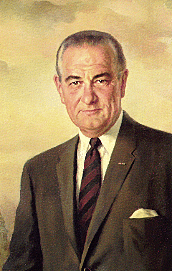
Maladies & Conditions
· familial heart disease · childhood infections · height and weight · smoking · type A personality · pneumonia · appendicitis · pneumonia · hand rashes · exhaustion or flu · kidney stones · heart attack #1 · ER angina · type A personality · daily naps · cholecystectomy · basal cell cancer · pneumonia · angina · sudden death
Odds & Ends ·
FAQ ·
Doctors ·
Resources ·
Cited Sources
Maladies and Conditions

Strong family history of heart disease. "According to family history passed on
to Lyndon from early times, all of the men in the Johnson family had died early
of heart disease"
2a.
This included his father, who developed coronary artery disease and died of it
at age 60
2a
3a.
Johnson would tell others that he would die early of heart disease
2a.
Comment:
This is a remarkable commentary on the progress made against heart disease in
the 20th century. His own situation appeared hopeless to Johnson, and to a
great extent it was. But
ten years after Johnson died (from heart disease) preventive
cardiology came into its own with statins, aspirin, aggressive blood
pressure control, and stronger anti-smoking efforts. Millions were saved
and continue to be. A younger southern president,
Bill Clinton,
owes his post-bypass life to better prevention of heart disease.

He had the "usual childhood diseases," including whooping cough
2b.

Johnson was six feet, three and a half inches tall
4a.
He had long arms
2a.
His facial features were from his maternal side: large ears and heavy eyebrows
2b.
There is no record of Johnson exercising regularly. In college, he grabbed and
gulped his food; this pattern persisted
2a.
By 1948 he was double-chinned and developing a paunch
2c.
As Senate majority leader, he was "overweight and flabby"
2a.

He began smoking in college, starting with a pipe, mostly to get attention
2a.
Later, he took up cigarettes. By 1937, his fingers were stained yellow
2d.
As a Congressman after World War II he was smoking three packs a day
2e.
His cardiologist,
Dr. J. Willis Hurst,
convinced him to stop smoking after his 1955 heart attack, but Johnson
resumed the habit after leaving the presidency
2f.
Comment:
No doubt the resumption accelerated his death.

Johnson drove himself, and everyone around him, mercilessly
2d.
He was intensely ambitious and would become depressed when he perceived
that his political career might flounder
2g.
For example, in 1948, he experienced "a period of depression" because he
wanted to run for the Senate, but greatly feared losing,
as that would cost him his seat in the House
2e.
Hospitalized for pneumonia, circa 1935
2d.

In 1937 Johnson campaigned ceaselessly for election to the House of Representatives.
He ate irregularly
and poorly, grabbing crackers, canned sardines, or cheese as time allowed,
while gagging and vomiting with proper meals. He lost weight and complained of
abdominal cramps that could double him over with pain.
Two days before the election, on April 8, he awoke with nausea and abdominal pain,
but kept his speech-making appointment. He had to sit down for a time during the
speech, but completed it. Covered with perspiration, he started to shake hands
with the crowd, then had to sit down... and could not get up. He was taken to a hospital,
and operated on for acute appendicitis. The organ was close to rupture.
2d
During a fact-finding trip to the south seas in World War II, Johnson
developed a fever in Hawaii and was ultimately hospitalized for pneumonia in Fiji
2e.

After the war, Congressman Johnson had a dry, scaly, red, uncomfortable rash
on his hands from time to time, to the point that he applied gauze dressings.
He also used Lubriderm ointment, keeping container on his desk that he dipped into.
Stress seems to have been a factor in this.
2e
Hospitalized in early 1946 for an illness variously described as flu, pneumonia,
or exhaustion. The illness lasted from New Year's Day until mid-February.
2e
He was hospitalized for renal colic in March 1946 and again, in October 1946 at the
Mayo Clinic, passing the stones without an operation
2h.
Three weeks before his all-important Senate election of 1948 he developed left
flank pain, but the stone did not pass and he was hospitalized again at the
Mayo Clinic, for a week during which he "had the doctors issue an almost hourly
statement that he was not going to die" — which he didn't, as the stone
again passed
2c
In January 1955 Johnson again had stone problems, and apparently had an operation
at the Mayo Clinic, convalescing until his return to the Senate in March
2c.
During his cholecystectomy in 1965, a stone was removed from a ureter
2i.


Johnson began feeling fatigued in end-June 1955. In the afternoon of July 2
he felt faint, short of breath, and nauseated, but thought he was having indigestion.
Another Senator, Clinton Anderson, who himself had had a heart attack, warned
Johnson that he could be having one. Johnson was rushed to Bethesda Naval Hospital,
where that evening he went into shock and nearly died. He was in critical condition
for several days and spent a total of six weeks in the hospital, followed by three
months at home, recuperating
2j.
Johnson was then 46 years old — young to have a heart attack.
Johnson later said "The strain of my work in the Senate had helped to bring on my
heart attack"
2k.
Of course, his smoking had a lot more to do with his heart attack than stress did.
Johnson's heart attack was big news at the time, but during his convalescence,
the sitting president,
Dwight Eisenhower,
had his heart attack, which took the attention off Johnson
1.
Johnson's heart attack became a political issue five years later when he was
running for the Democratic nomination for president against
John Kennedy,
whose campaign stated that the presidency required the
"strength, health, and vigor of a young man"
2k.
A heart attack typically causes abnormalities in the electrocardiogram (EKG),
and this occurred with Johnson. His EKG eventually returned to a normal state,
though not identical to his pre-heart-attack EKG
1.
One resident physician at Parkland, who was on his way to the emergency room after Kennedy
was brought in on November 22, 1963, later wrote:
As I turned to continue to Trauma Room 1, there was Lyndon Johnson, being ushered into one of the minor-medicine cubicles... His face was ashen, and he was holding his chest. Only recently, he had had a coronary, and I was afraid he was having another heart attack. 5aReports like these alarmed Kennedy's physician, Dr. Janet Travell. She summoned Johnson's cardiologist, Dr. J. Willis Hurst, to Washington. It turned out the reports were incorrect. In watching television that night with the newly sworn-in president, Hurst saw Johnson repeatedly mention his gratitude to Secret Service agent Rufus Youngblood, who threw his body on top of Johnson's as shots rang out. (Johnson had been in an open-air car behind Kennedy.) 6
Johnson's type A personality persisted into the presidency.
But Johnson loved it, saying: "I don't have ulcers. I give them!"
7a
According to Barry Goldwater, LBJ used two techniques to make his case:
the Half-Johnson ("when he just put a hand on your shoulder")
and the Full-Johnson ("when he put his arm clear around you and
thrust his face close to yours")
7b.
Johnson was troubled by dreams as president. This was not new, as he had been
similarly troubled as Senator and Vice President. In one dream as president,
his head was atop a thin, paralyzed body.
2i

"Napped every workday as President"
8a
(no primary source given).

After a gall bladder attack on Labor Day weekend in 1965, Johnson was advised to
have an operation, but wanted to keep his illness secret.
Dwight Eisenhower
advised him of the advantages of openness, however, and so the operation was
performed on October 8 at Bethesda Naval Hospital, with 10 doctors and
3 Secret Service agents in the operating room. It took 2 hours 15 minutes to
remove his gallbladder (with a stone) as well as a stone in his ureter.
2m.
Famously, he was later photographed showing his scar. Equally famously, the
photo was transformed into a devastating political cartoon that showed the
Viet Nam war's killing effect on the president by transforming the surgical
scar into a map of Viet Nam
9.
Interestingly, before the operation Johnson talked to his Vice President,
Hubert Humphrey, about contingencies if he (Johnson) became incapcitated
2i.

From 1963-1969 Johnson had 30-40 benign growths removed from his skin by
doctors at Bethesda Naval Hospital. No doubt a product of Johnson's early years
in Texas, he also had one malignant growth, a
basal cell cancer ("epithelioma"), removed from the lateral aspect of his
left ankle on Oct. 18, 1967. It never recurred.
10
All of these procedures and diagnoses were kept secret until 1977, years after
Johnson's death, when one of the consulting physicians made a statement to
Reader's Digest magazine, getting some of the details wrong. With the
consent of Johnson's widow, the Navy then released the correct details.
10
Reader's Digest reported that Johnson "declined to disclose it because
of deep concern that public reaction to the word "cancer" would far exceed
the seriousness of the medical situation"
10.
Comment:
And so, it appears that
Dwight Eisenhower's
earlier counsel on the benefits of openness, for Johnson's gall bladder disease,
went unheeded here. On the other hand, several later presidents have had skin
cancers removed without fuss, and one president,
Ronald Reagan,
had major cancer surgery (on his colon).
Johnson was hospitalized at Bethesda for pneumonia on Dec. 17, 1968
(from where he watched the launch of Apollo 8 on television).
His course was unremarkable.
2i
A worn and older-appearing Johnson retired to his Texas ranch, where he had
frequent chest pains (angina) that he appropriately treated with nitroglycerin.
He continued to drive and resumed smoking, both against his doctor's advice.
He reduced his exertions (common in angina patients), napped, and used oxygen
as needed.
2n

After his first heart attack, Johnson was always afraid of being alone
11a.
For example, when flying on Air Force One without his wife, he insisted that a
flight steward or White House aide stay in his compartment while he slept,
afraid that no one would be there to help if he had another heart attack
12a.
Toward the end, he seemed to know what was coming, when he said a solemn goodbye
to his cardiologist and friend of 18 years, who had been visiting at Johnson's ranch
1.
On the day he died, he spoke by phone with his physicians in the morning. No one
saw special reason for concern. His wife went out to do errands. At 3:50 pm
Johnson phoned the switchboard, asking for a Secret Service agent. Two responded
immediately, but found him dead on the floor of his bedroom. He was nevertheless
rushed by air to Brooke Army Medical Center, where he was declared dead on arrival.
2n
Autopsy showed that Johnson's cause of death was a large coronary occlusion.
His worry that he would die alone of a heart attack had come true.
He was 65.
2n
Odds and Ends
- In May 1966, LBJ received a note from his cook: "Mr. President, you have been my boss for a number of years and you always tell me you want to lose weight, and yet you never do very much to help yourself. Now I'm going to be your boss for a change. Eat what I put in front of you and don't ask for any more and don't complain." 7c
- Johnson visited the impoverished west African nation of Senegal while Vice President. "Against the advice of the ambassador, who urged him [Johnson] to shun contacts with villagers he [ambassador] described as dirty and diseased, Johnson visited a fishing village, where he handed out pens and lighters, shook hands with everyone, including some fingerless lepers, and urged the uncomprehending natives to be like Texans, who had increased their annual income tenfold in forty years" 4b.
- Johnson's official portrait was painted by a man named Heard. It is regarded in some circles, at least, to render Johnson ugly. Thus, a quip arose: "Presidential artists should be seen around the White House, but not Heard" 13.
- While Senate Majority Leader, Johnson needed a vote from a senator who had been rendered mute by disease (?stroke ?brain tumor). Johnson had the senator wheeled onto the Senate floor, and then had him point to his eye ("aye") when it came time to vote 11b.
- To hold down egg prices, Johnson had the Surgeon General issue a warning about the cholesterol content of eggs 11c.
Frequently Asked Questions (FAQ)
What was Lyndon Johnson's cause of death?
LBJ died from complications of coronary artery atherosclerosis, specifically a coronary artery thrombus (clot) that caused a fatal arrhythmia, superimposed on his history of heart attack, heart failure, and a recent resumption of smoking.
How many heart attacks did Lyndon Johnson have?
LBJ had a serious heart attack in 1955 at age 46 and died in 1973, at age 65, in the early minutes of what would likely have progressed to a second heart attack had he lived.
Doctors
Before Presidency
In Congress (maybe)
During Presidency
After Presidency
Resources
Disclaimer: If you buy through these affiliate links, I may earn a small commission at no extra cost to you.


Cited Sources
- Anonymous "DG". Past & President: J. Willis Hurst and LBJ. Emory Medicine Magazine. Pages 28-33, Autumn 1996. Available on the web at: https://web.archive.org/web/20160531030846/https://whsc.emory.edu/_pubs/em/1996fall/past_and_president.html
- Bumgarner, John R. The Health of the Presidents: The 41 United States Presidents Through 1993 from a Physician's Point of View. Jefferson, NC: MacFarland & Company, 1994. ISBN: 9780899509563. [Buy]
 a p.251 b p.250 c p.254 d p.252 e p.253 f p.257 g pp.252-254 h pp.253, 254 i p.256 j pp.254-255 k p.255 m pp.255-256 n pp.257

Comment: Devotes one chapter to each President, through Clinton. Written for the layperson, well-referenced, with areas of speculation clearly identified, Dr. Zebra depends heavily on this book. Dr. Bumgarner survived the Bataan Death March and has written an unforgettable book casting a physician's eye on that experience. - Montgomery-Massingberd, Hugh (ed). Burke's Presidential Families of the United States of America. 2nd ed. London: Burke's Peerage Limited, 1981. ISBN: 9780850110333. [Buy]
 a p.551
Comment: Maps -- in great detail -- the ancestors and descendants of American presidents through Ronald Reagan. They would have had an exhausting time with President Obama's family tree! MORE - Dallek, Robert. An Unfinished Life: John F. Kennedy 1917-1963. Boston: Little, Brown, 2003. ISBN: 9780316172387. [Buy]
 a p.354 b pp.349-350
- Crenshaw, Charles A.; Hansen, Jens; Shaw, J. Gray. JFK: Conspiracy of Silence. New York: Signet, 1992. ISBN: 9780451403469. [Buy]
 a p.76
Comment: This book has been roundly criticized by other physicians involved in the Kennedy case. - Grimes, William. Dr. J. Willis Hurst, Cardiologist to Lyndon B. Johnson, Dies at 90. New York Times. October 8, 2011. Available on the web at: http://www.nytimes.com/2011/10/09/health/09hurst.html
- Boller, Paul F. Jr. Presidential Anecdotes. New York: Oxford University Press, 1981. ISBN: 9780195029154. [Buy]
 a p.309 b p.311 c p.323
- DeFrank, Thomas M. Write It When I'm Gone: Remarkable Off-the-Record Conversations with Gerald R. Ford. New York: G.P. Putnam's Sons, 2007. ISBN: 9780399154508. [Buy]
 a p.225
- Levine, David. Johnson's scar. (Downloaded on 2026-11-03.) Available on the web: https://hti.osu.edu/opper/lesson-plans/cold-war-conflict-in-vietnam-the-vietnam-era-presidency/images/johnsons-scar
- Altman, Lawrence K. Navy Confirms Johnson Had Surgery for Skin Cancer. New York Times. June 29, 1977. Available on the web at: https://www.nytimes.com/1977/06/29/archives/navy-confirms-johnson-had-surgery-for-skin-cancer.html
- Califano, Joseph A. The Triumph and Tragedy of Lyndon B. Johnson. New York: Simon & Schuster, 1991. ISBN: 9780671664893. [Buy]
a pp.28 and 342 b pp.54-55 c pp.137-138
- Walsh, Kenneth T. Air Force One: A History of Presidents and Their Planes. New York: Hyperion, 2003. ISBN: 9781401300043. [Buy]
 a pp.83-84
- Pachter, Marc. [remark made while interviewing Mark Updegrove]. Booktv. C-SPAN2, 5 November 2006.
Comment: Pachter was at the time Director of the National Portrait Gallery.
Other Sources
George Washington · John Adams · Thomas Jefferson · James Madison · James Monroe · John Q. Adams · Andrew Jackson · Martin van Buren · William Harrison · John Tyler · James Polk · Zachary Taylor · Millard Fillmore · Franklin Pierce · James Buchanan · Abraham Lincoln · Andrew Johnson · Ulysses Grant · Rutherford Hayes · James Garfield · Chester Arthur · Grover Cleveland · Benjamin Harrison · Grover Cleveland · William McKinley · Theodore Roosevelt · William Taft · Woodrow Wilson · Warren Harding · Calvin Coolidge · Herbert Hoover · Franklin Roosevelt · Harry Truman · Dwight Eisenhower · John Kennedy · Lyndon Johnson · Richard Nixon · Gerald Ford · Jimmy Carter · Ronald Reagan · George Bush · William Clinton · George W. Bush · Barack Obama · Donald Trump.45 · Joseph Biden · Donald Trump.47