
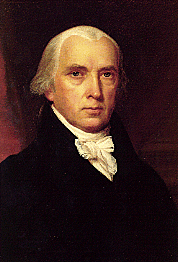
Health and Medical History of President James Madison
President #4: 1809-1817
Lived 1751-1836
Lived 1751-1836
"James Madison... belonged in that category of medical paradoxes whose longevity belies
their constitutional frailty."
1

Health and Medical History of President
James Madison
President #4: 1809-1817
Lived 1751-1836
Lived 1751-1836
↓


 Lived 1751-1836
2026
1776
Lived 1751-1836
2026
1776
 Revolutionary War1776-1783
War of 18121812-1815
Mexican-American War1846-1848
Civil War1861-1865
Spanish-American War1898-1899
World War 11917-1918
World War 21941-1945
Korean War1950-1953
Viet Nam War1964-1975
Desert Storm1990-1991
Bush's Wars2001-2021
Iran War2026-Now
Revolutionary War1776-1783
War of 18121812-1815
Mexican-American War1846-1848
Civil War1861-1865
Spanish-American War1898-1899
World War 11917-1918
World War 21941-1945
Korean War1950-1953
Viet Nam War1964-1975
Desert Storm1990-1991
Bush's Wars2001-2021
Iran War2026-Now
Lived 1751-1836
2026
1776
Revolutionary War1776-1783War of 18121812-1815Mexican-American War1846-1848Civil War1861-1865Spanish-American War1898-1899World War 11917-1918World War 21941-1945Korean War1950-1953Viet Nam War1964-1975Desert Storm1990-1991Bush's Wars2001-2021Iran War2026-Now
"James Madison... belonged in that category of medical paradoxes whose longevity belies
their constitutional frailty."
1
 |
UNDER CONSTRUCTION |
Maladies & Conditions
· small · infection fears · "ill" · functional disorders · epilepsy? · frostbite · chronic cholecystitis · arthritis · aging · infirm · faded away
Odds & Ends ·
Doctors ·
Resources ·
Cited Sources
Maladies and Conditions

"Physically Madison was always frail in appearance, short of stature, and slight."
He never weighed more than 100 pounds. His height is a little uncertain: five feet, four to
six inches.
1

Madison, from a well-to-do Virginia family, would ordinarily have gone to college at
William and Mary. But malaria was common in that area of southeastern Virginia, and so
his physician strongly urged him to go elsewhere
2a.
He therefore attended Princeton. Decades later, one of his classmates, Aaron Burr,
introduced Madison to woman who had been widowed in the great Philadelphia
yellow fever epidemic of 1793. Although Madison was 17 years older than her,
and a head shorter, he was by then famous as a founding father, and so she accepted his
proposal to become Dolley Madison
3a.

After graduating from Princeton (in only two years), Madison did not immediately return home,
saying that he was too ill to travel
2a.
Physicians would often label him as frail throughout his [long] life. They would prescribe various
programs to increase his strength and stamina, sending him once to recuperate at Warm Springs,
a spa in western Virginia
2a.

During his teens and early twenties, Madison complained of a voice impairment. This was
"a functional handicap that prevented his public speaking until age 30"
1.
In this period of his life,
Madison escaped the scourges of his day, i.e. malaria, smallpox, tuberculosis, and yellow
fever, but was neurotically convinced that his body harbored some insidious disease -- an
obsession he overcame only after tremendous determination
1.

Madison may or may not have had a seizure disorder. On July 28, 1775 (age 24) he collapsed
during a military drill while being watched by his father, among others. Abrupt spells
would continue to afflict him the rest of his life.
Madison wrote that he had "a constitutional tendency to sudden
attacks somewhat resembling epilepsy which suspended all intellectual function.... They
continued throughout my life with prolonged intensity"
4a.
After his death, his brother-in-law attempted to describe this illness in the best possible
light. In three drafts, he descibed Madison's "constitutional liability to sudden
attacks" variously as: "of the nature of epilepsy, " "of a character and
effect which suspended his powers of action," and as the reason Madison did not enter
military service
4b.
Comment:
Imagine if Madison had joined the military and been killed before writing the Constitution!
Writers since 1940 have spilled much ink debating whether Madison's spells were a
psychiatric illness or a physical illness. Psychiatrically, labels such as
"doubtless hysteric"
1,
"epileptoid hysteria"
5a,
"conversion reactions"
3b,
and panic attacks
4c
have been proposed -- all of which may be classed as
"psychogenic non-epileptic seizures"
4c.
Others believe that Madison had the physical illness of epilepsy,
perhaps with petit mal seizures
2b.
Comment:
It would be interesting to tabulate all eye-witness accounts of Madison's spells, looking
for the motor and autonomic epiphenomena that typically accompany petit mal seizures
6a.

While out campaining for the First Congress in 1788, Madison's nose became frost-bitten, leaving
a scar. In later years, he would jokingly claim it as "his scar of a wound received in
defense of his country"
7a.


Chronic arthritis afflicted Madison from middle age onwards
1.
In his late 70s Madison was still mentally sharp. In 1828, one visitor found his conversation
"a stream of history... so rich in sentiments and facts, so enlivened by anecdotes and
epigrammatic remarks, so frank and confidential as to opinions on men and measures, that it
had an interest and charm, which the conversation of few men now living, could have."
Physically, Madison's "little blue eyes sparkled like stars from under his bushy grey
eyebrows and amidst the deep wrinkles of his poor thin face"
7a.
With age, his complexion became yellowish, and his eyes "blepharitic"
1
(i.e. puffiness around the eyes).
By the fall of 1831 (age 80), he was doing poorly. His wife wrote to a friend:
My dear Husband is still confined to his bed -- In addition to a disabling Rheumatism throughout the winter, he has had a bilious fever, which has reduced him so much that he can only walk from one bed to another. I never leave him, more than a few minutes at a time, and have not left the enclosure around our house for the last eight months on account of his continued indisposition ... Our Physicians have advised the warm springs for Mr Madison, and we hoped to have him taken there, but as he could not travel unless conveyed in his bed, we dare not think of it for the present. 1

By his early 80s, Madison started to fade away. His vision and his hearing deteriorated, and
he grew thinner and weaker
1.
During his final illness in summer 1836, he refused the requests of friends to take stimulants
in order to prolong his life until July 4, the 60th anniversary of the Declaration of Independence.
7b
(Both
Thomas Jefferson
and
John Adams
had died on the 50th anniversary, July 4, 1826). Finally, one morning, a few days before the
4th, Madison was found dead in his bedroom, sitting in front of his untouched breakfast tray
1.
Comment:
Goes to show that even in the 1800s, breakfast trays were handed to patients without realizing
they were dead!
Odds and Ends
- Madison was the second cousin of Zachary Taylor 8a. At one time it was erroneously thought that Madison and George Washington were distant cousins 8b.
Doctors
During Presidency
Resources
Disclaimer: If you buy through these affiliate links, I may earn a small commission at no extra cost to you.





Brant Series
Brant Series
Brant Series
Brant Series
Brant Series
Brant Series
Cited Sources
- [no author listed]. Mr. President -- your health: James Madison (1751-1836). Minnesota Medicine. 1967;50:1500. Pubmed: 4861781.
Comment: Does not cite its sources. One wonders if Marx was a source. - Bumgarner, John R. The Health of the Presidents: The 41 United States Presidents Through 1993 from a Physician's Point of View. Jefferson, NC: MacFarland & Company, 1994.
 a p.26 b p.27Comment: Devotes one chapter to each President, through Clinton. Written for the layperson, well-referenced, with areas of speculation clearly identified, Dr. Zebra depends heavily on this book. Dr. Bumgarner survived the Bataan Death March and has written an unforgettable book casting a physician's eye on that experience.
- Marx, Rudolph. The Health of the Presidents. New York: GP Putnam's Sons, 1960.
 a p.68 b p.70Comment: Tells great tales, but the book does not cite its sources.
- Signer, Michael. Becoming Madison: The Extraordinary Origins of the Least Likely Founding Father. New York: PublicAffairs, 2015.
a p.93 b p.92 c p.91
- Brant, Irving. James Madison: The Virginia Revolutionist, 1751-1780. New York: Bobbs-Merrill, 1941.
a p.107 cited by Signer p91
- Engel, Jerome. Seizures and Epilepsy. (Contemporary Neurology Series, volume 31.) Philadelphia: F.A. Davis.
a p.157
- Boller, Paul F. Jr. Presidential Anecdotes. New York: Oxford University Press, 1981.
 a p.47 b p.48
- Montgomery-Massingberd, Hugh (ed). Burke's Presidential Families of the United States of America. 2nd ed. London: Burke's Peerage Limited, 1981.
 a p.127 b p.45Comment: Maps -- in great detail -- the ancestors and descendants of American presidents through Ronald Reagan. They would have had an exhausting time with President Obama's family tree! MORE
Other Sources
George Washington · John Adams · Thomas Jefferson · James Madison · James Monroe · John Q. Adams · Andrew Jackson · Martin van Buren · William Harrison · John Tyler · James Polk · Zachary Taylor · Millard Fillmore · Franklin Pierce · James Buchanan · Abraham Lincoln · Andrew Johnson · Ulysses Grant · Rutherford Hayes · James Garfield · Chester Arthur · Grover Cleveland · Benjamin Harrison · Grover Cleveland · William McKinley · Theodore Roosevelt · William Taft · Woodrow Wilson · Warren Harding · Calvin Coolidge · Herbert Hoover · Franklin Roosevelt · Harry Truman · Dwight Eisenhower · John Kennedy · Lyndon Johnson · Richard Nixon · Gerald Ford · Jimmy Carter · Ronald Reagan · George Bush · William Clinton · George W. Bush · Barack Obama · Donald Trump.45 · Joseph Biden · Donald Trump.47