
Health and Medical History of President James Garfield
President #20: 1881-1881
Lived 1831-1881
Lived 1831-1881

Health and Medical History of President
James Garfield
President #20: 1881-1881
Lived 1831-1881
Lived 1831-1881
↓


 Lived 1831-1881
2026
1776
Lived 1831-1881
2026
1776
 Revolutionary War1776-1783
War of 18121812-1815
Mexican-American War1846-1848
Civil War1861-1865
Spanish-American War1898-1899
World War 11917-1918
World War 21941-1945
Korean War1950-1953
Viet Nam War1964-1975
Desert Storm1990-1991
Bush's Wars2001-2021
Iran War2026-Now
Revolutionary War1776-1783
War of 18121812-1815
Mexican-American War1846-1848
Civil War1861-1865
Spanish-American War1898-1899
World War 11917-1918
World War 21941-1945
Korean War1950-1953
Viet Nam War1964-1975
Desert Storm1990-1991
Bush's Wars2001-2021
Iran War2026-Now
Lived 1831-1881
2026
1776
Revolutionary War1776-1783War of 18121812-1815Mexican-American War1846-1848Civil War1861-1865Spanish-American War1898-1899World War 11917-1918World War 21941-1945Korean War1950-1953Viet Nam War1964-1975Desert Storm1990-1991Bush's Wars2001-2021Iran War2026-Now
 |
UNDER CONSTRUCTION |
Maladies & Conditions
· writing · "ague" · bad cold · anal fissure · "weak stomach" · height & weight · assassination · rectal feeding · abdominal cramping · foot pain · infarct · malpractice
Odds & Ends ·
Doctors ·
Resources ·
Cited Sources
Maladies and Conditions

Could simultaneously write Greek with one hand and Latin with the other.
1a

For six weeks when he was 15, Garfield drove horses along the narrow towpaths running beside
the Ohio canal network. After falling into the water for literally the 14th time, Garfield
developed fever, chills, exhaustion, and became bedridden for weeks. This illness was diagnosed
as an "ague," which was then a term applied generically to any malaria-like illness.
He was treated with large doses of calomel, a chloride of mercury with cathartic properties.
At that time it was the standard treatment for any fever.
2
Garfield had a bad cold in 1851 that was treated by a homeopathic practitioner, Alpheus Morrill,
with "cold cloths applied to the chest and infinitesimal doses of medicine."
2

Garfield had a "weak stomach" for years.
2

"Garfield was elected president at age 49. He was six feet in height and weighed 185 pounds,
and was characterized as 'very strong, atheletic and energetic."
2

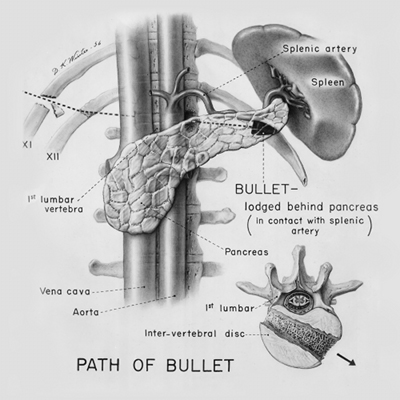
On July 2, 1881, Charles J. Guiteau fired two bullets from his Bulldog .44 at Garfield. One
caused a superficial arm wound. The other entered in the right posterior thorax, fractured
rib 11, traveled leftward and anteriorly into the L1 vertebral body, then lodged about 2.5
inches to the left of the spine, below the inferior border of the pancreas.
 3
3
(President Garfield's spine is held by the National Museum of Health and Medicine. It was on
display in 2000, and apparently shows the path of the bullet
4.)
The whereabouts of this second bullet was a mystery until the autopsy, despite even the
efforts of Alexander Graham Bell. Bell used his newly invented "induction balance,"
better known now as
a metal detector, to attempt locating the bullet.
1b
3
For some period after the shooting, Garfield was fed rectally
1c.
Comment:
It would be interesting to know if this was an innovation at the time and whether, due to absorptive
peculiarities of the rectum, this could have led to a deficiency state of any kind.
After the shooting, Garfield was treated with high maintenance doses of quinine (5 to 10 grains
per day) and morphine (one-fourth grain daily), frequent sips of brandy, and a single dose
of calomel. Garfield had chronic abdominal symptoms during his convalescence. They were ascribed
to the calomel by one of the homeopathic practitioners attending him.
2
MORE

Pendel
5a
heard this from a White House steward, Mr. Crump, hours after Garfield died:
He was always so cheerful and had so much nerve. Why, he used to astonish me with his jokes, even while he was suffering horribly. Suffer? I should say he did. The first week or ten days it was his feet. He kept saying, "Oh, my God! my feet feel as though there were millions of needles being run through them." I used to squeeze his feet and toes in both my hands, as hard as I possibly could, and that seemed the only relief he could get.Comment: This presumably relates to a post-shooting time. It is difficullt to know what to make of this symptom. It doesn't sound like gout (squeezing would be excruciating). Vascular or neurological causes seem most likely.




At his trial, the assassin Guiteau admitted shooting the President, but denied killing him.
Instead, he claimed that Garfield's physicians killed him. Although Guiteau was executed because
his defense was not strong enough, he was probably correct.
Garfield's original wound was 3.5 inches long, and ended with the bullet lodged in a harmless
part of the abdomen. The wound was probed by the fingers of numerous physicians during the
rest of Garfield's life so that, by the time of his death, the wound track was 20 inches long
and oozing pus.
It seems reasonable that the terminal event in Garfield's life was a myocardial infarction.
However, the wound could have contributed to the terminal event in three ways, all of them
derived from the fact that Garfield was mightily infected for a period of 3 months:
- It seems reasonable to suppose that Garfield had anemia of chronic disease, which would have lowered the ischemic threshold.
- Chronic infection could have led to amyloidosis. If it affected the heart, then it is not surprising that an ischemic event would have been so rapidly fatal.
- It is becoming increasingly clear that coronary atherosclerosis is an inflammatory, perhaps infectious, disease. It is possible that Garfield's chronic inflammation and infection could have accelerated atherosclerosis.
Odds and Ends
- Both Garfield and his wife were particularly sympathetic to homeopathy. His first cousin, and boyhood neighbor, Silas Boynton, was a homeopathic practitioner. In 1875 Garfield asked Boynton to consult with the physicians caring for his dying mother-in-law. In 1881, while living in the White House, Garfield's wife Lucretia developed malaria, and Boynton was summoned again. Boynton recommended that Mrs. Garfield, who was severely ill, be transferred to the New Jersey seashore, away from the malarious swamps that reached the backyard of the White House. During Garfield's final illness, Boynton and another homeopath (Susan Edson) attended Garfield, but as nurses. 2
- "Some people say that prayer has saved the President. They may think so. In my opinion it was whiskey." Dr. -- D. W. Bliss, physician caring for Garfield after the shooting 6a. (Interestingly, Grant's physician once said just the opposite.)
- Dr. Bliss later died of sepsis (blood poisoning), contracted when he cut his hand while dressing one of Garfield's wounds. 1e [But the Roos article says he died in 1889...]
- Garfield's medical bill was $18,500. 1d
Doctors
Before Presidency
During Presidency
Assassination
Shooting (First Day)
- Joseph K. Barnes
- David Low Huntington
- Charles Mason Ford
- William James Chamberlain Du Hamel
- Smith Townshend
- Basil Norris
- Robert Reyburn
- Seth R. Beckwith
- Susan Ann Edson
- John Brown Hamilton
- Joseph Janvier Woodward
- Francis M. Gunnell
- Charles Burleigh Purvis
- DeWitt Clinton Patterson
- Nathan Smith Lincoln
- Joel Pomerene
- Philip Skinner Wales
- Doctor Willard Bliss
Shooting (in Washington)
Shooting (in New Jersey)
Resources
Disclaimer: If you buy through these affiliate links, I may earn a small commission at no extra cost to you.


Cited Sources
- Brooks, Stewart M. Our Murdered Presidents: The Medical Story. New York: Frederick Fell, 1966.
a p.56 b p.89 c p.85 d p.?? e p.125Comment: LCC shelving code R703 B873 1966.
- Deppisch, LM. Homeopathic medicine and presidential health: homeopathic influences upon two Ohio presidents. Pharos. Fall 1997;60:5-10. Pubmed: 9385827.
Comment: Discusses the relationships of Garfield and Harding with homeopathy. Also reprints a Currier & Ives drawing of "The Death of General James A. Garfield, Twentieth President of the United States." - Drawing by Duncan Winter.
- Reif, Wanda. Medical curiosities in cabinets. Out of the blue cabinets. Exhibition at the National Museum of Health and Medicine Washington, DC, USA, showing until May 21, 2000. (Review). Lancet. 2000;355:1467.
- Pendel, Thomas F. Thirty-Six Years in the White House. Washington: Neale Publishing Company, 1902.
 a pp.115-116Comment: Pendel was door-keeper at the White House from the time of Lincoln to the time of Theodore Roosevelt. Full text is available on-line at loc.gov. It is a rather dry book, and reads as if it were written by an old man. http://memory.loc.gov/cgi-bin/query/D?lhbcbbib:1:./temp/~~ammem_rEou::
- Boller, Paul F. Jr. Presidential Anecdotes. New York: Oxford University Press, 1981.
 a p.171
Other Sources
George Washington · John Adams · Thomas Jefferson · James Madison · James Monroe · John Q. Adams · Andrew Jackson · Martin van Buren · William Harrison · John Tyler · James Polk · Zachary Taylor · Millard Fillmore · Franklin Pierce · James Buchanan · Abraham Lincoln · Andrew Johnson · Ulysses Grant · Rutherford Hayes · James Garfield · Chester Arthur · Grover Cleveland · Benjamin Harrison · Grover Cleveland · William McKinley · Theodore Roosevelt · William Taft · Woodrow Wilson · Warren Harding · Calvin Coolidge · Herbert Hoover · Franklin Roosevelt · Harry Truman · Dwight Eisenhower · John Kennedy · Lyndon Johnson · Richard Nixon · Gerald Ford · Jimmy Carter · Ronald Reagan · George Bush · William Clinton · George W. Bush · Barack Obama · Donald Trump.45 · Joseph Biden · Donald Trump.47