
47⬅ Donald Trump: About Systemic Amyloidosis

Quicklinks







Matters before 2021 are covered on the
Trump.45 page.
Donald Trump's second term has been dominated by an obvious physical decline 1 that administration officials have steadfastly ignored, even as equally steadfast allies publicly fear for his health 2. At age 80, hard data in Trump's most recent medical report point to a disease called systemic amyloidosis:
Donald Trump's second term has been dominated by an obvious physical decline 1 that administration officials have steadfastly ignored, even as equally steadfast allies publicly fear for his health 2. At age 80, hard data in Trump's most recent medical report point to a disease called systemic amyloidosis:
- His blood pressure is 105/71, down 20 points (in the top number) from his lifelong excellent readings.
- His ankles are chronically and untreatably swollen ("edematous").
- His heart squeezes well, when seen on cardiac ultrasound.
More...
About amyloidosis
Amyloidosis is an "infiltrative" disease. That is, abnormally behaving "amyloid" proteins slowly and irreversibly infiltrate from the blood into bodily tissues, causing a gradual decline in organ function. In the heart, this is called "cardiac amyloidosis." The heart becomes stiff and less efficient — a state called "heart failure" — which shortens life. Heart problems often lead to the diagnosis of amyloidosis. The rest of this page is the bare minimum to understand this ailment, which might be afflicting President Trump. There is no shortage of additional information on the internet.Asides appear like this.
Key clinical features of amyloidosis
- Some organs are more sensitive to the infiltration of amyloid protein than other organs are. These sensitive organs develop problems before the others. Patients experience problems in one organ after another over a period of years.
- Amyloidosis is difficult to diagnose. There is no simple blood test for it, and it offers no clear signals of its presence. As their medical problems slowly accumulate in one organ after another, patients (and their physicians) commonly shrug and think it's just aging.
- Until recently, amyloidosis was considered a rare disease. It is increasingly clear that the process is quite common in the elderly, though not always severe.
- Yet, amyloidosis is a serious disorder. It becomes especially dangerous when the heart becomes infiltrated and gets stiffer and stiffer. Treatment can slow down the infiltration, but so far there are no treatments to reverse the infiltration.
The definitive tests for amyloidosis
To make a formal diagnosis of amyloidosis requires one of two tests: (a) a biopsy sample stained with a particular red stain, and/or (b) a "TcPYP" nuclear scan of the heart. Only a positive result from one of these tests can convert suspicion into diagnosis.Chemicals other than TcPYP are used in Europe. Interestingly, the TcPYP scan is technically a bone scan. For reasons unknown, an amyloidosis heart lights up as if it were made of bone!To ensure trustworthy results from the nuclear scan, a third test is needed. This "third test" is a simple blood draw and urine collection that are analyzed in three ways. Details: "AL amyloidosis can be essentially excluded by obtaining a monoclonal protein screen comprising 3 laboratory tests: serum free light chain assay, SIFE [serum immunofixation electrophoresis], and UIFE [urine immunofixation electrophoresis]" — together they have a >99% sensitivity for detecting the AL type of amyloidosis 3.Alas. the TcPYP scan can make mistakes. MOREThere is no public record that Donald Trump has ever had either definitive test.
Which organs are affected, and when?
The sequence of organ involvement varies from patient to patient. But there are general trends that depend on the sub-type of systemic amyloidosis (discussed later). You won't, however, go too wrong with the following heuristics:
- The long nerves extending to the feet and hands are generally affected early.
- So are the small blood vessels in the skin, which become fragile and prone to breakage.
- The heart is noticeably affected somewhat later. Infiltration of the heart makes the heart tissue stiff, which is bad because the mechanical efficiency of the heart depends on it being pliable. People with amyloidosis often die from their stiff heart. Once the heart is affected, the disease can appear to move fast.
Is the brain affected?
I leave this question to others. However, there can be little doubt that cardiac amyloidosis indirectly affects higher brain function. Heart failure causes a profound physical fatigue and, just as profoundly, can disturb sleep. These effects impair mental acuity, attention span, and stamina — traits that brief cognitive questionnaires don't measure.
Types of amyloidosis
Amyloidosis can be restricted to one organ, but that is unusual. The term "systemic amyloidosis" is used when multiple organs are involved. This website is wholly about systemic amyloidosis. Sloppily, I have often dropped the word "systemic." The commonly-used phrase "cardiac amyloidosis" refers to the condition where the heart has been infiltrated by amyloid proteins. Cardiac amyloidosis is almost always due to systemic amyloidosis.
Sub-types of amyloidosis
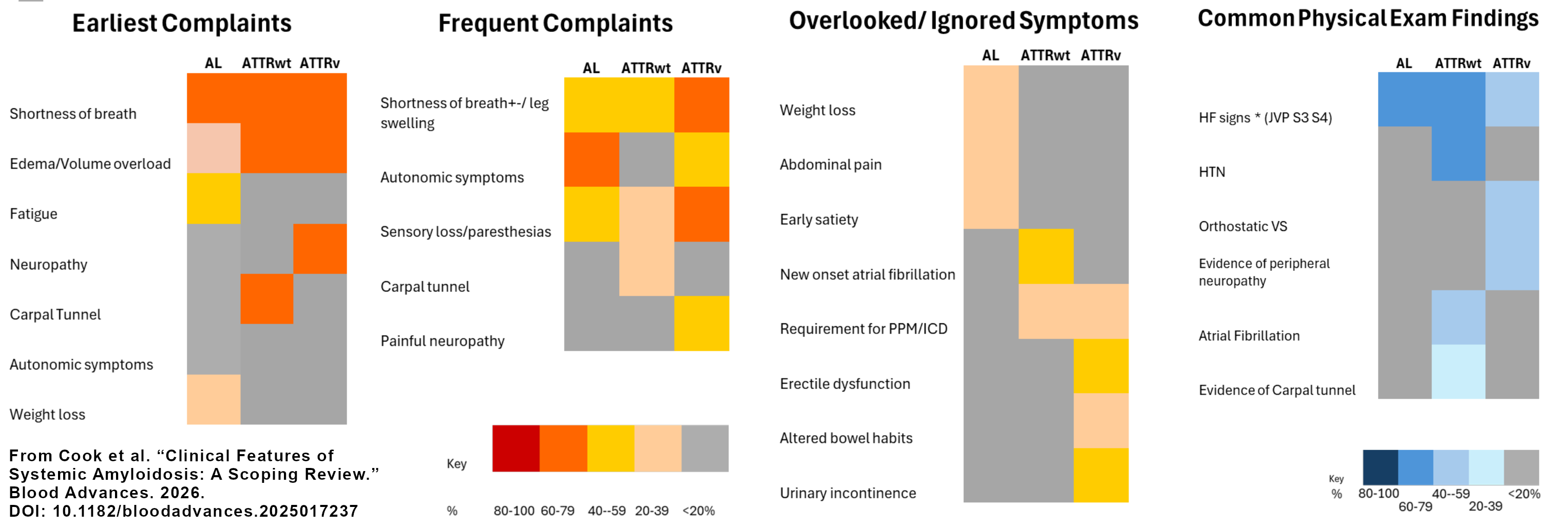
[This is advanced material you can safely ignore.] Systemic amyloidosis can arise from different causes. These causes define its sub-types, which have ridiculous, unhelpful, confusing names:There are subtle differences between the various sub-types of systemic amyloidosis. The excellent illustration below, from 4, summarizes their differences in signs and symptoms. (Alas, it ignores kidney involvement.)
- AL amyloidosis: arises from cancer or cancer-like conditions
- AA amyloidosis: arises from chronic inflammation (least common in USA)
- ATTRv amyloidosis: arises from a genetic cause, even in advanced years
- ATTRwt amyloidosis: generally arises in older people, with no identifiable cause
At some later time it will be necessary to try to identify which sub-type of systemic amyloidosis Trump might have. But that is too much detail for this stage of the analysis, so I am largely ignoring the issue of sub-types for now. Input from physicians is welcome, but first read the "Doubts" page. MORE Signs and symptoms of the sub-types of amyloidosis. From 4.
Cited Sources
- Reiner, Jonathan. I Was Dick Cheney's Cardiologist. Trump Has Not Looked Well, and We Should Know Why. New York Times. Aug. 12, 2026. Available on the web at: https://www.nytimes.com/2026/08/12/opinion/trump-health-questions.html
- Chavez, Paloma. Bill O'Reilly Urges Trump, 80, to Take a Month Off for His Wellbeing: "You Need a Breather". People. July 23, 2026. Available on the web at: https://people.com/bill-oreilly-urges-trump-take-month-off-12025441
Comment: O'Reilly's comment is startling in its similarity to the Chicago Tribune's editorial of March 22, 1865, which said of a "worn and weakened" Abraham Lincoln: "He needs a least a month's entire rest from his official duties." (See The Physical Lincoln Complete, pp 105, 387-388.) Lincoln was then in the advanced stages of cancer, as discussed in The Physical Lincoln. - Kittleson MM, et al. 2023 ACC Expert Consensus Decision Pathway on Comprehensive Multidisciplinary Care for the Patient With Cardiac Amyloidosis. Journal of the American College of Cardiology. 2023; 81(11):1076-1126. Available on the web at: https://doi.org/10.1016/j.jacc.2022.11.022
- Cook J, et al. Clinical Features of Systemic Amyloidosis: A Scoping Review. Blood Advances. 2026; 10(14): 5097-5112. Available on the web at: https://doi.org/10.1182/bloodadvances.2025017237
- Ruberg FL, et al. Transthyretin Amyloid Cardiomyopathy JACC State-of-the-Art Review. Journal of the American College of Cardiology. 2019; 73: 2872-2891. Available on the web at: https://doi.org/10.1016/j.jacc.2019.04.003
- Nativi-Nicolau JN, et al. Screening for ATTR amyloidosis in the clinic: overlapping disorders, misdiagnosis, and multiorgan awareness. Heart Failure Reviews. 2022; 27: 785-793. Available on the web at: https://doi.org/10.1007/s10741-021-10080-2
George Washington · John Adams · Thomas Jefferson · James Madison · James Monroe · John Q. Adams · Andrew Jackson · Martin van Buren · William Harrison · John Tyler · James Polk · Zachary Taylor · Millard Fillmore · Franklin Pierce · James Buchanan · Abraham Lincoln · Andrew Johnson · Ulysses Grant · Rutherford Hayes · James Garfield · Chester Arthur · Grover Cleveland · Benjamin Harrison · Grover Cleveland · William McKinley · Theodore Roosevelt · William Taft · Woodrow Wilson · Warren Harding · Calvin Coolidge · Herbert Hoover · Franklin Roosevelt · Harry Truman · Dwight Eisenhower · John Kennedy · Lyndon Johnson · Richard Nixon · Gerald Ford · Jimmy Carter · Ronald Reagan · George Bush · William Clinton · George W. Bush · Barack Obama · Donald Trump.45 · Joseph Biden · Donald Trump.47