
47⬅ Donald Trump: Report Irregularities / Alterations

Quicklinks

Report irregularities
President Trump's May 2026 medical report
contains many irregularities, organized here into
familiar information-corrupting buckets
that impede efforts to understand his health:
Although the irregularities in the reports raise many questions — especially the changed normal ranges SEE BELOW — an outsider finds many obstacles to understanding their origin and significance. Too much of the relevant information is available only to insiders. Genuinely innocent reasons could have propelled some of the irregularities into the report, so full judgment must await access to the inside information.
- MORE Omissions ... of multiple test results
- MORE Ignorings ... of multiple clinical problems
- SEE BELOW Alterations ... of normal test ranges
- MORE Decoy ... with irrelevant material
- MORE Ambiguities ... of dates and phrasing
- MORE Misdiagnoses ... and incomplete diagnoses
- MORE Fawning ... including previous reports
Although the irregularities in the reports raise many questions — especially the changed normal ranges SEE BELOW — an outsider finds many obstacles to understanding their origin and significance. Too much of the relevant information is available only to insiders. Genuinely innocent reasons could have propelled some of the irregularities into the report, so full judgment must await access to the inside information.

Chronic anemiaMORE
Unrecognized by the press, Trump has a poorly treatable chronic anemia,
apparent since May 2026
MORE.
(It is "poorly treatable" because it has not been successfully treated!)
Through Sep. 2026, the anemia has not been acknowledged in any way by the president's medical
reports. In fact, it can be hypothesized that the president's reports were
engineered to draw attention away from the anemia.
SEE BELOW
The cause of the anemia is unknown. It is not simple aging.
Anemia can occur as a complications of systemic amyloidosis.
Iron deficiency (a cause of anemia) is common in both heart faiure and cardiac amyloidosis
1.
More...
The May 2026 medical report on President Trump
MORE
introduced new normal ranges for two laboratory tests, thereby reclassifying the
president's decaying blood numbers as clearly normal. To provide a final nudge,
one number was rounded. All 16 other blood tests kept their 2025 range, except
a cousin of the rounded number.
Asides appear like this.
Primary Observations
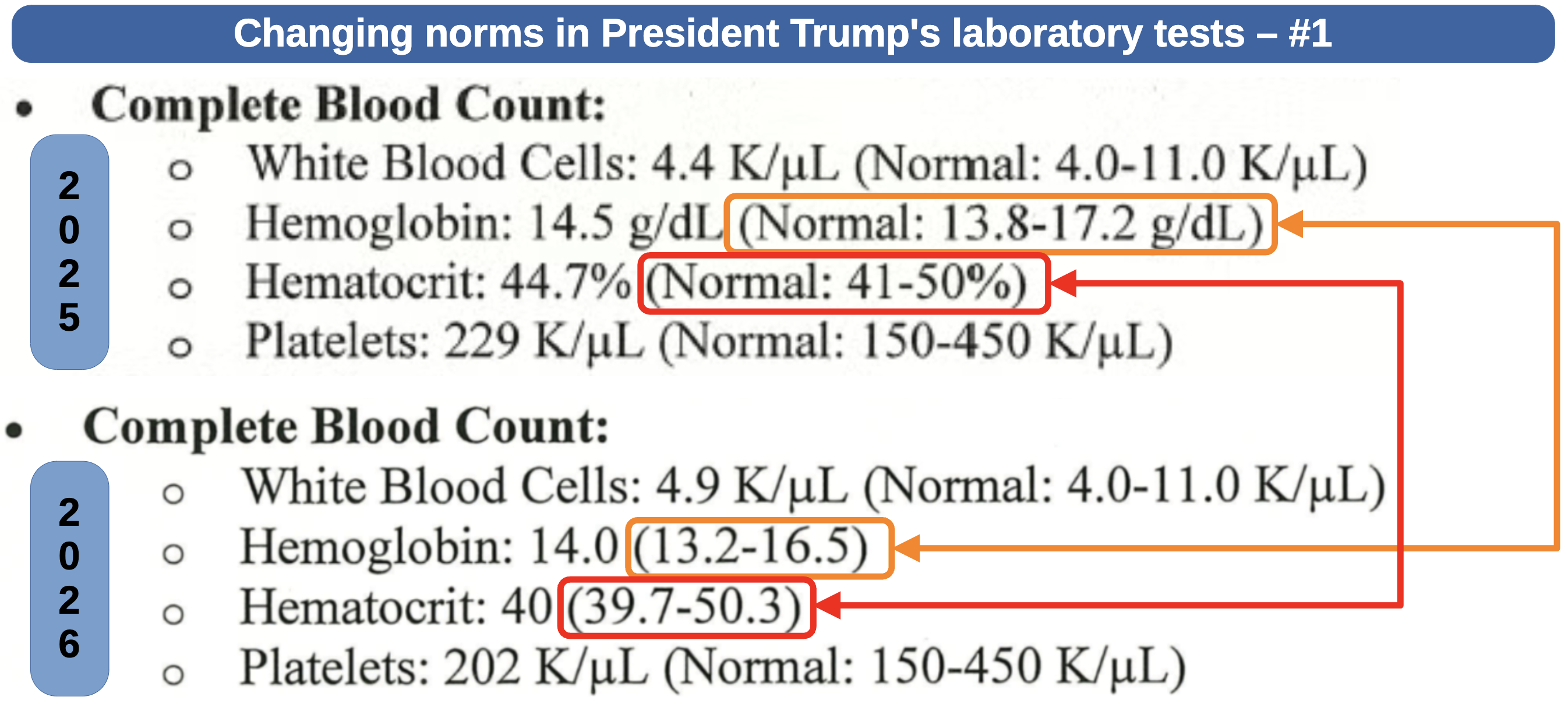
The image below compares screenshots from the 2025 and 2026 medical reports on the president's health. Colored arrows highlight the year-to-year inconsistencies in the normal ranges of two tests: the hematocrit and the hemoglobin concentration.
- The 2026 inconsistency in the hematocrit normal range, indicated by the red arrows, resulted in the president's hematocrit landing inside the normal range.
- The normal range for hemoglobin in 2026 was adjusted in the same direction as the hematocrit's, and is indicated by orange arrows. The adjustment landed the president's hemoglobin value further away from the borderline of abnormality.
Using the standard heuristic that the hematocrit is 3x the hemoglobin, lowering the hemoglobin range by 0.6 equates to lowering the hematocrit by 1.8 ... which is actually more, on a relative basis, than the lowering of the hematocrit range! This is a pretty large swing, and one wonders how that could be medically justified. Furthermore, when equated by the 3x rule, the hemoglobin change of 1.8 (in hematocrit units) is nearly 40% more than the actual hematocrit change of 1.3 — a difference for which it difficult to identify a physiological reason.
Full recap
The clinical aspects of the president's anemia are discussed elsewhere. MORE This recap concentrates on the laboratory aspects of the anemia.
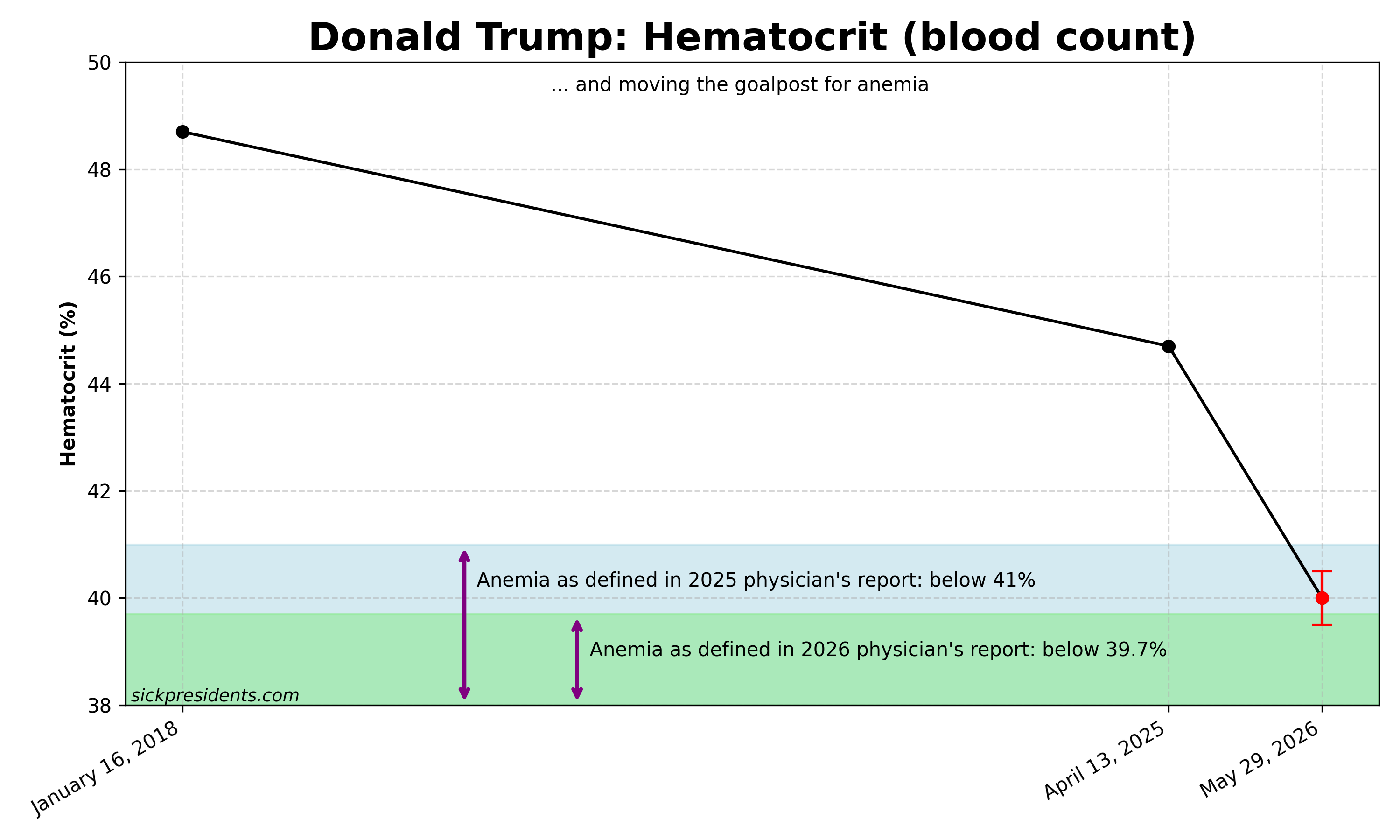
- The president's hematocrit was solidly inside the normal range in 2025.
- However, when it fell to 40% in 2026, that would have been rated abnormally low ("anemic") by the standard of the 2025 report.
- For whatever reason, the normal range for hematocrit was adjusted downward in 2026, compared to 2025.
- By adjusting the hematocrit's lower limit of normal downward to 39.7%, the president's value of 40% in 2026 continued to be classified as normal, as it had been in 2025.
- The inconsistency introduced in the 2026 normal range for hematocrit favors a more benign view of the president's health by suggesting the president's hematocrit in 2026 was inside the normal range, and therefore not anemic.
- The effect of down-shifting the normal range for hematocrit is shown here for the president's hematocrit history (the vertical error bars are explained later):
Some hematology background
The hematocrit measures the percentage of the blood volume that is occupied by red blood cells. Anemia is present when the hematocrit level is below the normal range. The hemoglobin and hematocrit tests measure the same essential characteristic of the blood. In most circumstances their differences are not worth expounding, so the last thing we will say about the hemoglobin test is that its normal range changed in the same direction as the hematocrit's.Nor do we discuss the clinical implications of the president having a low hematocrit, i.e. anemia. Another page discusses that MORE. Our discussion here is about shifting norms in the 2026 medical report.Anemia is always a serious problem in men. Responsible physicians must never overlook it. Anemia can cause symptoms like fatigue and exercise limitation. More importantly, it can be the harbinger of lethal diseases. Thus, if the president were to have anemia, extensive public discussion of its implications would be expected. We do not here try to argue the proper normal range for the hematocrit measurement.The Red Cross has more experience with the blood of healthy Americans than any other organization. They define the lower limit of normal hematocrit as 41% in a man — the value that was used in the 2025 medical report of the president and later revised downward in 2026.
Possible alibis
It might be argued that olid justifications triggered the down-shifting the normal range for hematocrit. Shifts in the normal range for a lab test do indeed happen in some circumstances, but that is rare, and those circumstances are not apparent here:Those explanations should suffice. Definitive proof could be obtained by examining the medical records of other people who had their hematocrit measured by the same laboratory as the president. (Almost certainly the Walter Reed hospital lab.) If the normal range cited in these non-presidential records remained fixed from 2025 to 2026, then it would be strong evidence that the president's report was treated specially in some way. For the sake of argument, let us pretend that the bullet points above still leave you convinced that the shift in the hematocrit normal range were completely forthright. You should then consider the following additional evidence.
- Alibi: A new technique to measure the test was introduced. No. The last real innovation in measuring the hematocrit and hemoglobin was decades ago, when centrifuges were largely replaced by blood analyzer machines for routine assessments. Uncounted millions of hematocrit tests have been run every year for decades, and it would cause insanity if the normal range wobbled around.
- Alibi: Studies of the population show that a shift in normal hematocrit values occurred on a wide scale. No. No new studies like that have appeared. The World Health Organization published new data in early 2024, but that was for the world as a whole, which includes countries with poor nutrition and extraordinary burdens of chronic disease, so it would not well apply to the United States. Furthermore, their data excluded people above the age of 60, which of course covers most people in American hospitals.
- Alibi: The patient is discovered to belong to a special population in which the original method of measurement is inaccurate, so a different method of measurement (still under the name "hematocrit") is adopted. Unlikely. The usual reason to abandon one test for another may be tied to the patient having some specific blood disease, e.g. sickle cell anemia. President Trump's prior medical reports have not mentioned a blood disease.
- Alibi: Matters of convenience, speed, or accuracy drive a change in measurement technique for a particular patient. Unlikely. Let's consider the possibility that the president was moved from spun hematocrit to blood analyzer hematocrit, or vice versa. The spun hematocrit tends to run a bit higher than readings from a blood analyzer. So, if the president in 2025 had a spun hematocrit and a blood analyzer hematocrit, then that could explain the downward shift in normal range. This is not likely, however, because spun hematocrits do not produce a reading for hemoglobin concentration, but there is a hemoglobin value listed for 2025. We can therefore be pretty certain that a blood analyzer was used for both the 2025 and 2026 readings.
Secondary observations #1: The BUN
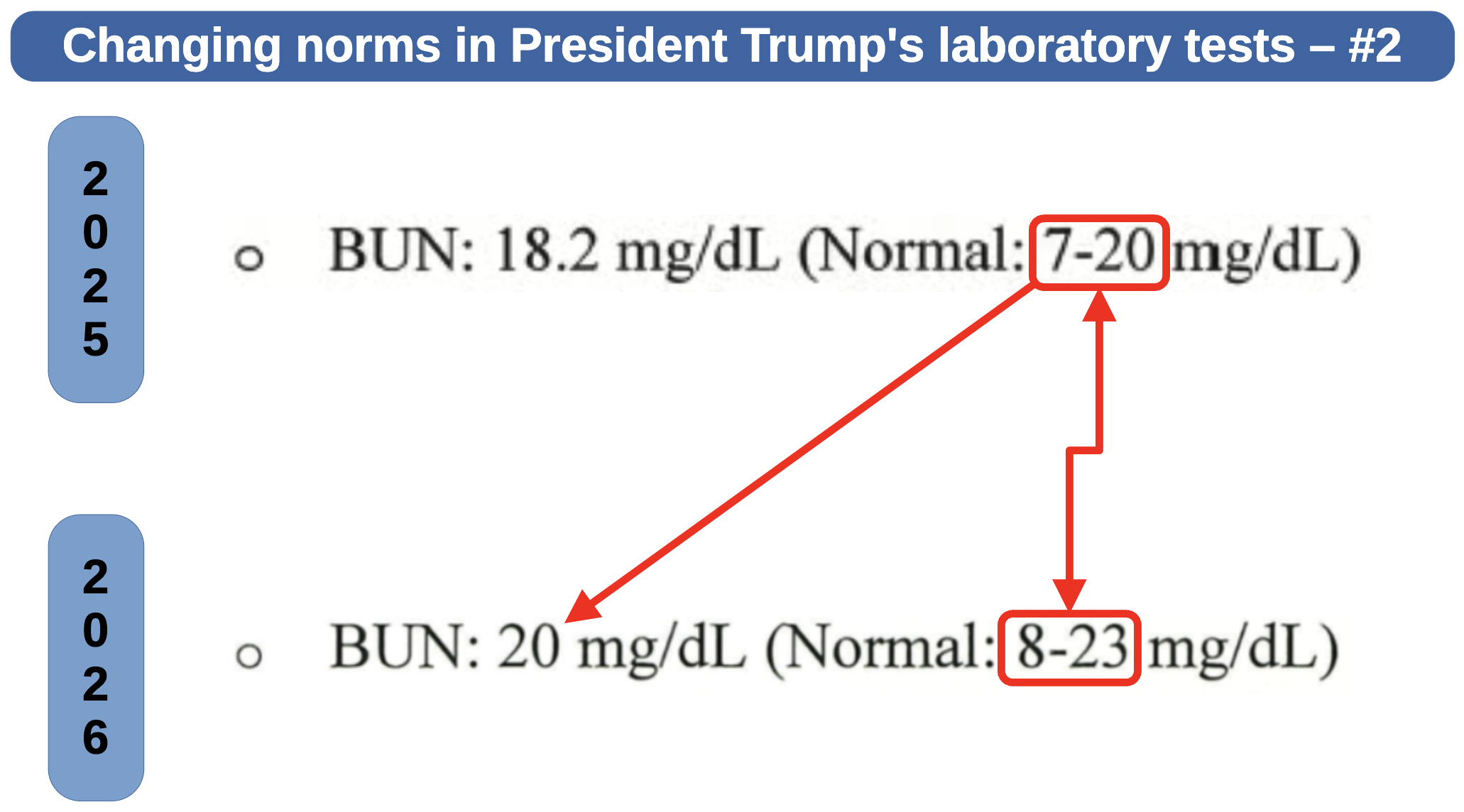
The rest of the tests in the president's medical reports can inform our view of the change in the hematocrit normal range. The figure below compares normal ranges for the blood urea nitrogen ("BUN") measurement, which is a kidney test, in 2025 and 2026.Remarkably, the normal range for BUN has been shifted here, too, with the same effect as the shift in the hematocrit normal range. That is, the president's BUN level was nicely in the normal range in 2025, but if the 2026 report had used the 2025 normal range, then the president's 2026 BUN level would have been exactly on the borderline, which would have drawn attention to the president's kidney function. For the BUN test, higher-than-normal levels indicate that the kidneys are unable to meet the demands imposed upon them. Like the hemoglobin and hematocrit, the BUN is one of the most common blood tests in all of medicine.Taking a more expansive view, we observe that:Thus, the BUN finding adds considerable weight to the hypothesis that normal ranges are shifted in order to preserve an air of normality for the president. The next section adds still more evidence.
- Among the president's 17 blood tests reported in both 2025 and 2026, there were only 3 that had their normal range shifted: hematocrit, hemoglobin, and BUN.
- In all 3 cases of shifting, the shift was in a direction that moved the president's value away from the borderline of normal range and closer to the middle of the normal range.
- In the case of hematocrit and BUN, the shift in normal range prevented the president's value from being outside the normal range or exactly on the border of the normal range.
- In all 3 cases of shifting, the shift in the normal range would have an expected effect of stimulating less discussion about the president's health.
Secondary observations #2: Rounding
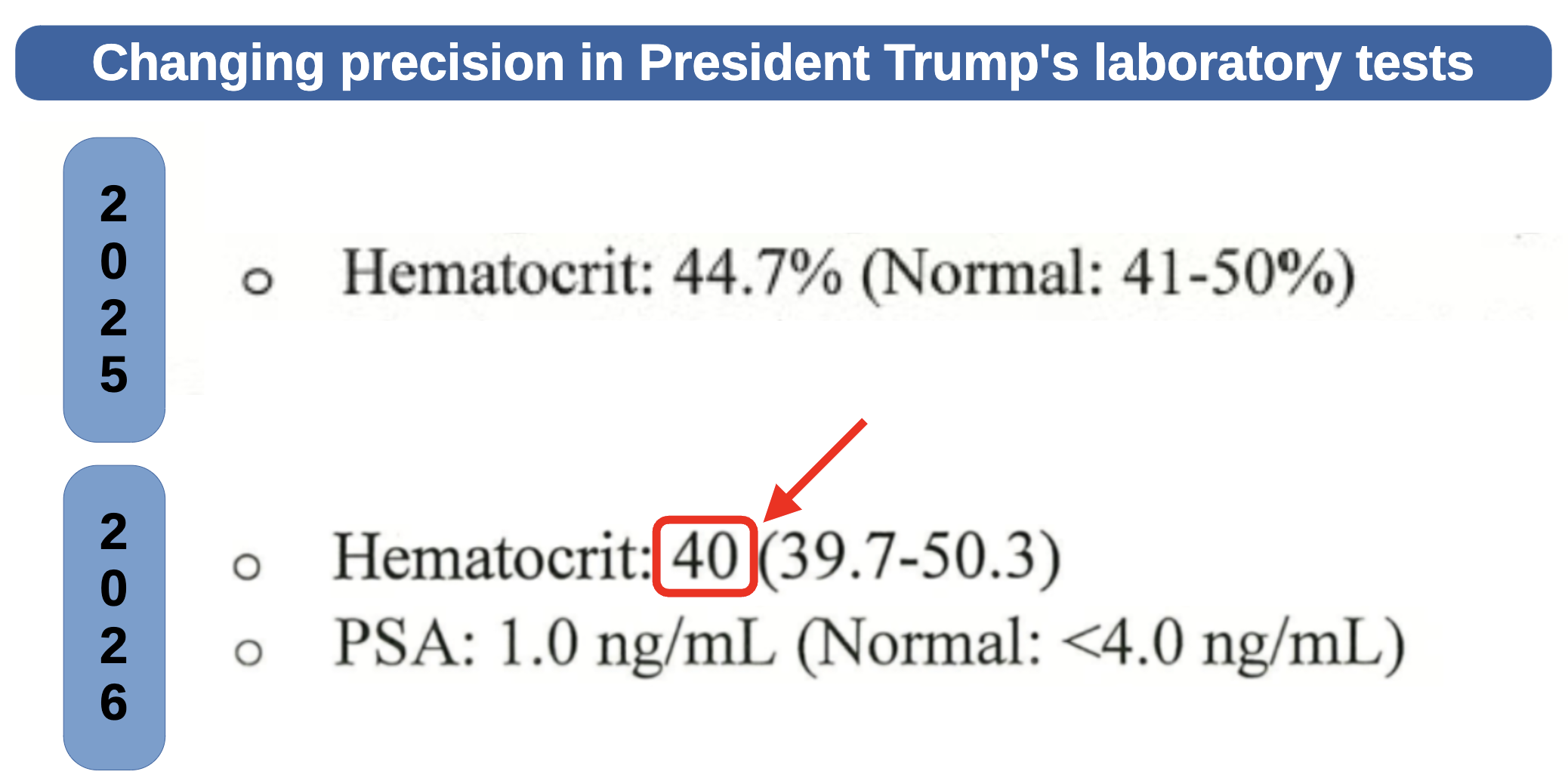
The reporting of the president's hematocrit in 2026 was inconsistent with past years in a second respect: it reported only two significant digits instead of three. That is, it said "40" not "40.0".Although 40 and 40.0 are the same number in terms of magnitude, they are different numbers in terms of precision. The 40 is really saying 40±0.5, i.e. it could vary from 39.5 to 40.5 (well, 40.49999999). By contrast, 40.0 is really saying 40±0.05: ten times more precise (from 39.95 to 40.05). A simpler way to say this is that the true hematocrit value was rounded to "40" in the 2026 report, which means the true value is somewhere between 39.5 and 40.5 — we don't know where. The president could even have an abnormal value according to the new 2026 normal range (example: 39.6), and yet with rounding it could appear to be in the normal range. This is illustrated by the vertical error bar in the graph of the president's hematocrit values, above, which spans 39.5 to 40.5. Like the shifting of normal ranges for hematocrit, rounding has the effect of lessening the attention to the president's blood count, and reducing discussion of his anemia. Some may object that such concerns about precision result from over-scrutinizing a mere typographical convention. Such arguments fail to convince, for several reasons:
- The normal range for the 2026 hematocrit test includes three significant digits, and so one would expect three significant digits in the reported value.
- As shown above, Trump's 2026 report states that the PSA level is "1.0" not "1", and further above that the hemoglobin level is "14.0" not "14", meaning that the author of the report regards a trailing zero as conveying information that is worth recording.
- Rounding an abnormal number into the normal range, which cannot be excluded here, would be a big deal, capable of collapsing trust in the physician's report.
Medical conclusions
Together, the primary observations and the secondary observations expose a large number of irregularities:This is a long list.
- hematocrit normal range in 2026 shifts to keep the president's value normal
- BUN normal range in 2026 shifts to keep the president's value from being on the exact borderline of normal
- hemoglobin normal range in 2026 shifts to keep the president's value closer to the middle of the normal range
- all other normal ranges in 2026 (14 tests) are unchanged from 2025, and none of these 14 tests approach closely to a 2026 boundary of normal
- the 2026 report stripped the most significant digit from the 2026 hematocrit value, not in keeping with the treatment of two other results where the most significant digit was a zero
- it cannot be excluded that the hematocrit value in 2026 is a rounded value in which the true, full precision value was outside the normal range and then rounded into the normal range
Speculation
With no other sensible explanation that could be applied, a reasonable person might conclude that the 2026 medical report contains "editorial decisions" that are too skewed to be coincidence, random drift, or anything but a deliberate effort to present the president's medical status in an artificially positive light.
Cited Sources
- Jobbé-Duval A, et al. Prevalence and determinants of iron deficiency in cardiac amyloidosis. ESC Heart Failure. 2022; 9: 1314-1327. Available on the web at: https://doi.org/10.1002/ehf2.13818
George Washington · John Adams · Thomas Jefferson · James Madison · James Monroe · John Q. Adams · Andrew Jackson · Martin van Buren · William Harrison · John Tyler · James Polk · Zachary Taylor · Millard Fillmore · Franklin Pierce · James Buchanan · Abraham Lincoln · Andrew Johnson · Ulysses Grant · Rutherford Hayes · James Garfield · Chester Arthur · Grover Cleveland · Benjamin Harrison · Grover Cleveland · William McKinley · Theodore Roosevelt · William Taft · Woodrow Wilson · Warren Harding · Calvin Coolidge · Herbert Hoover · Franklin Roosevelt · Harry Truman · Dwight Eisenhower · John Kennedy · Lyndon Johnson · Richard Nixon · Gerald Ford · Jimmy Carter · Ronald Reagan · George Bush · William Clinton · George W. Bush · Barack Obama · Donald Trump.45 · Joseph Biden · Donald Trump.47