
Health and Medical History of President George Bush
President #41: 1989-1993
Lived 1924-2018
Lived 1924-2018

Health and Medical History of President
George Bush
President #41: 1989-1993
Lived 1924-2018
Lived 1924-2018
↓


 Lived 1924-2018
2026
1776
Lived 1924-2018
2026
1776
 Revolutionary War1776-1783
War of 18121812-1815
Mexican-American War1846-1848
Civil War1861-1865
Spanish-American War1898-1899
World War 11917-1918
World War 21941-1945
Korean War1950-1953
Viet Nam War1964-1975
Desert Storm1990-1991
Bush's Wars2001-2021
Iran War2026-Now
Revolutionary War1776-1783
War of 18121812-1815
Mexican-American War1846-1848
Civil War1861-1865
Spanish-American War1898-1899
World War 11917-1918
World War 21941-1945
Korean War1950-1953
Viet Nam War1964-1975
Desert Storm1990-1991
Bush's Wars2001-2021
Iran War2026-Now
Lived 1924-2018
2026
1776
Revolutionary War1776-1783War of 18121812-1815Mexican-American War1846-1848Civil War1861-1865Spanish-American War1898-1899World War 11917-1918World War 21941-1945Korean War1950-1953Viet Nam War1964-1975Desert Storm1990-1991Bush's Wars2001-2021Iran War2026-Now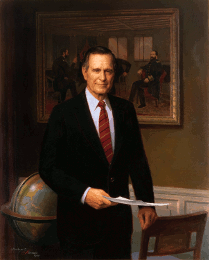
Maladies & Conditions
· staph infection · forehead gash · bleeding ulcers · fitness enthusiast · height · blood type O-positive · eye blinking · physical exams · arthritis · mucoid cyst · mild glaucoma · eye sty · dyed hair · atrial fib · Graves disease · depression? · conjugal Graves · Japan puke · stops Halcion · stress · actinic keratoses · actinic keratoses
Odds & Ends ·
Doctors ·
Resources ·
Cited Sources
Maladies and Conditions

As a high school senior Bush almost died from a staphylococcal infection in his right arm.
He spent weeks recovering at Massachusetts General Hospital. Antibiotics, in the form of sulfa
drugs, were available in that era, but, curiously, they were not used
1a.

Bush's plane was downed twice during his service as a Naval Aviator in World War II. On the
second occasion, he struck his head on the tail of the airplane as a result of being ejected
from the plane, sustaining a deep gash in his forehead. Effects from smoke in the cockpit and
swallowing seawater after landing in the Pacific Ocean nauseated him. He was rescued by an
American submarine some hours later
1b.

Bush had bleeding ulcers in the 1950s-1960s timeframe, the last apparently in 1960.
He also suffered from heartburn about this time, which he treated with Pepto-Bismol
1c.

Bush came from athletic parents and has participated in athletics and fitness activities most
of his life. He began playing tennis at age 5 and was on the baseball team in college. He began
regular jogging at age 51, while head of the CIA. In 1991 he was quoted as saying: "I
used to do four miles in about eight minutes and fifty seconds per mile, but age has been catching
up with me."
1d.

Bush is 6 feet 2 inches tall
2.

Both George and Barbara Bush are O-positive
3a.


Eye blinking is known to increase during times of stress or mental activity. Psychologist Joseph
Tecce of Boston College has studied blink rates and the Presidency. During the 1988 Presidential
debates against Michael Dukakis, Bush blinked an average of 67 times per minute, and Dukakis
75. Tough questions raised the rates: Bush blinked 89/min when asked about abortion, and Dukakis
92/min when asked about taxes. Easier questions dropped the rate: Dukakis blinked 53/min when
he joked about "being likable" and Bush 44/min when praising Vice Presidential candidate
J. Danforth Quayle
4.

Bush underwent four complete physical examinations during his four years in office, plus at
least one less formal examination. The press releases are available
MORE.
The few remarkable findings from the physicals are discussed elsewhere on this page.

"Mild degenerative arthritis [joint unspecified] which has been present for several years"
was noted on the 1989 physical examination. The degree of his symptoms are unclear
5a.
A one centimeter mucoid cyst on the "third digit [sic] on the middle finger" of Bush's
right hand was surgically removed under local anesthesia at Walter Reed Army Medical Center
on Oct. 6, 1989
MORE
5b.
(The "third digit" reference perhaps means third phalanx.)
A "sebaceous cyst" on the third finger of his right hand had been drained at
the time of his physical five months earlier. The cyst, undoubtedly the same as the one removed,
had been present for many years
5a.
"An early glaucoma of [the] left eye" was noted during Bush's physical in April 1990.
He was started on Betagan eye drops, 1 drop every 12 hours
5c.
After re-examination two weeks later by specialists from Johns Hopkins and the Mayo Clinic,
it was decided to stop the eye drops and to follow him closely
MORE
5d.
A sty in Bush's right eye was treated with antibiotics and soaks in 1990
5c.
Heimel claims that Bush had one or more patches of orange hair at one or more times, and interprets
this as evidence that he was dying his hair
6.


While jogging at Camp David on a Saturday afternoon (May 4, 1991), Bush developed shortness
of breath, chest tightness, and a general feeling of fatigue. A White House physician discovered
Bush had a rapid irregular heartbeat, ultimately diagnosed as atrial fibrillation due to hyperthyroidism
(see below).
7
MORE
Bush was transferred to Bethesda Naval Hospital by helicopter. His ventricular rate was
150/min
1e.
Cardiologist
Dr. Allen M. Ross
prescribed digitalis, procainamide, and Coumadin
7.
(Note: Digitalis slows the heart, procainamide can change the rhythm pattern from atrial
fibrillation back to normal, and Coumadin prevents blood clots, one of the main complications
of atrial fibrillation.)
Abrams writes:
According to the doctors' plan, if the drugs failed to affect the arrhythmia -- as initially they did -- an electrical shock would be administered the following day, a common way of returning a patient's rhythm to normal. When it was announced that Dan Quayle would be acting president under the Twenty-fifth Amendment provisions while Bush was under anesthesia for the cardioversion -- if it was required -- a different kind of shock reverberated across the nation. The prospect of Quayle as president brought home sharply the electorate's lack of confidence in his ability to lead. 3bThe drugs were effective. By 10:25 pm on May 5, Bush's heart rhythm was normal. About 5 am the following morning, however, atrial fibrillation recurred. It was decided (by whom?) to continue the drugs rather than use electrical cardioversion. Bush returned to the White House later that day. 3b. Comment: It would be useful to have information on how long Bush used these medications. Both digitalis and procainamide can affect higher mental function.
Graves disease was diagnosed immediately after the occurrence of atrial fibrillation. Bush
had been feeling increasingly tired over the preceding two weeks, had lost nine pounds in two
months, and had seen his handwriting deteriorate. Physical examination disclosed a fine tremor
of his hands and slight enlargement of his thyroid gland (goiter). Bush was hyperthyroid.
7
MORE
"President Bush and the team of physicians caring for him agreed that his hyperthyroidism
should be treated in the safest, fastest, most definitive, and permanent way possible. Therefore,
he took an oral dose of radioactive iodine a few days after being admitted to the hospital"
7.
Two days later Bush began a ten day course of potassium iodide (SSKI), four drops three times
a day, to prevent a rare complication of radio-iodine therapy called "thyroid storm"
(extreme hyperthyroidism).
The treatment worked. "Within a few months" Bush's thyroid was no longer over-producing
thyroid hormone. In fact, it was now producing too little (a common occurence after radiation
treatment). Thus, Bush began taking, for the rest of his life, a pill containing synthetic
thyroid hormone known as "Synthroid"
7.
Comment:
For a few days, radio-iodine treatment generally makes the patient radioactive to a degree
that can jeopardize others who come too close. For this reason, such treatments are generally
given in the hospital. Lower levels of radiation persist longer, however. As far back as 1986
the White House contained radiation detectors
8.
It would be interesting to know whether the detectors had to be turned off or re-calibrated
after Bush had his radiation treatment. It would also be interesting to know how physical access
to the President was controlled while he was radioactive.
The listless second half of the Bush presidency, as well as his uninspired campaign for re-election
in 1992, raises the question of whether he suffered depressive or other psychological sequelae
of his thyroid disease. There is no objective evidence for this yet -- it is pure, weak speculation.
Watching a few semi-candid clips of Bush from October 1992
9
only strengthens an impression of mental lassitude
MORE.
Asked by Larry King what disease he (Bush) had just had, Bush replied "Crohn's? No, not
Crohn's. Uh, just thyroid." An apathetic- and listless-appearing Bush also seemed to think
that Halcion (a sleeping pill he had taken) was a decongestant.
Comment:
Either Bush was amazingly ignorant of his medical issues, or he was not firing on all cylinders.

Bush's wife, Barabara, had earlier been diagnosed with Graves disease. The odds of two people
(not related by blood) developing Graves disease within a two years of each other are long
(Doctor Zebra has seen a one-in-three-million number
7,
but thinks this answers the wrong question.)
The Bush dog, Millie, came down with Graves disease, too
10,
although there are reports Millie had a different auto-immune disease: lupus
7.
Because of the remarkable coincidence of three cases of auto-immune disease in one household,
the Secret Service tested the water in the White House, at Camp David, at the Vice President's
residence, and at Walker's Point (Bush's home in Maine) for lithium and iodine, two substances
"known to cause thyroid problems"
5e.
MORE.
In January 1992, while at a formal dinner in Japan, Bush became ill. He vomited on the Prime
Minister of Japan, then fainted. Earlier in the evening, Bush had told his physician he was
feeling unwell
1f.
Bush disregarded
Dr. Burton Lee's
advice to skip the dinner
11
MORE.
It proved to be nothing more than "the flu," but coming on the heels of Bush's
diagnoses of atrial fibrillation and Graves disease in the preceding 12 months, there was concern
over his physical health
MORE.
Comment:
During the episode Bush had the appearance of a man suffering an inferior-wall myocardial infarction.
An electrocardiogram was, however, normal. It's not clear what the Japanese Prime Minister
thought of all this. One is left to ponder the immortal line from the immortal movie Animal
House: "Flounder, you didn't just throw up in front of Dean Wormer, you threw up on
Dean Wormer!"
Interestingly, Bush's son
George W. Bush
also suffered a syncopal episode while President.

On Feb. 5, 1992 the White House announced that Bush would no longer take Halcion, a sleeping
pill that had been banned in Great Britain and was ultimately withdrawn from the American market.
There had been questions whether Halcion was responsible for the President's "tangled
syntax" or his illness in Japan
1g.
Listening to him discuss Halcion with Larry King, it seems that Bush was a fan of the
medicine
MORE.
Bumgarner cites reports that Bush's physicians recommended a more relaxing schedule for the
President after his March 26, 1992 physical, due to the great deal of stress Bush had been
under
1g.

Bush was treated for sun-induced pre-cancerous lesions on his face in August 2002
12.
Bush's son,
George W. Bush,
had a similar procedure 8 months earlier.
Comment:
The photograph accompanying the reference suggests cryotherapy (liquid nitrogen) was used.
Odds and Ends
- Bush's dog would get "psychosomatically paralyzed, any time George and Bar went away" 13a.
- Sometime in the 1996-2002 range, Bush's personal physician, Dr. Benjamin Orman, declared: "Mr. Bush does not look his age, is unusually healthy, exercises frequently, and continues to go at a brisk pace" 7.
- Bush's son is George W. Bush. Various web sites say the Bush family is related to the Spencer family, of which Princess Diana of Wales was a member.
Doctors
In Congress (maybe)
During Presidency
After Presidency
Resources
Disclaimer: If you buy through these affiliate links, I may earn a small commission at no extra cost to you.


Cited Sources
- Bumgarner, John R. The Health of the Presidents: The 41 United States Presidents Through 1993 from a Physician's Point of View. Jefferson, NC: MacFarland & Company, 1994.
 a p.288 b p.289 c p.290 d pp.289-291 e p.292 f p.294 g p.295Comment: Devotes one chapter to each President, through Clinton. Written for the layperson, well-referenced, with areas of speculation clearly identified, Dr. Zebra depends heavily on this book. Dr. Bumgarner survived the Bataan Death March and has written an unforgettable book casting a physician's eye on that experience.
- Mathews J. The shrinking field. Washington Post. August 3, 1999. Page C1.
Comment: Accessed through washingtonpost.com: http://www.washingtonpost.com/wp-srv/politics/campaigns/wh2000/stories/tall080399.htm - Abrams, Herbert L. "The President Has Been Shot": Confusion, Disability, and the 25th Amendment in the Aftermath of the Attempted Assassination of Ronald Reagan. New York: W. W. Norton & Company, 1992.
 a pp.59-60 b p.261Comment: Rigorous and enormously thought provoking. Abrams tells not only the story of the shooting itself, but, more importantly, the maneuvering to disguise Reagan's slow recovery afterwards and forestall any consideration of transferring power to the Vice President.
 - Jaret, Peter. Blinking and thinking. In Health. July/August 1990; 4(4): 36-37.
- White House Press Release. [various topics]. George H.W. Bush Public Papers. (Kept in the Bush Presidential Library, College Station, TX).
a Statement by Press Secretary Fitzwater on the Results of the President's Physical Examination, May 10, 1989 b Statement by Press Secretary Fitzwater on the President's Hand Surgery, October 6, 1989 c Statement by Press Secretary Fitzwater on the President's Physical Examination, April 12, 1990 d Statement by Press Secretary Fitzwater on the President's Eye Examination, April 25, 1990 e Statement by Press Secretary Fitzwater on the President's Health, May 28, 1991 f Statements by Press Secretary Fitzwater on the President's Physical Examination, March 26, 1992Comment: Downloaded 26-27 November 2003 from: http://bushlibrary.tamu.edu/papers/
- Heimel, Cynthia. Combover Congress: how can we trust our leaders to manage impeachment when they can't even manage their hair?. Salon.com. Feb. 3, 1999.
Comment: Caveat emptor: no written source for these statements is known to Dr. Zebra. Available on the web at: http://www.salon.com/news/1999/02/03newsb.html - The Thyroid Society. Graves' disease: the heart of the matter. [On line]. Accessed 16 December 2002.
Comment: See: http://the-thyroid-society.org/graves.html - Toltzis RJ, Morton DJ, Gerson MC. Problems on Pennsylvania Avenue. N Engl J Med. 1986 Sep 25;315(13):836-7. Pubmed: 3748102.
- Springer, Brian. Spin. [Movie, 1995]. Accessed 6 July 2006.
Comment: This movie is largely composed of clips from 1992 television satellite feeds. These feeds are usually not broadcast in their entirety. For example, satellite feeds can include recordings made during commercial breaks or before a show starts. With the proper equipment, anyone can pick up satellite feeds (although they may be encrypted). 57 minutes 26 seconds. Movie accessed at: http://www.brasscheck.com/videos/spin.html - Ebner SA, Badonnel MC, Altman LK, Braverman LE. Conjugal Graves disease. Ann Intern Med. 1992 Mar 15;116(6):479-81. Pubmed: 1739238.
- Hedger B. White coats in the White House: Former presidential physicians reflect on their service. AMedNews. Mar. 23, 2009.
Comment: http://www.amednews.com/article/20090323/profession/303239973/4/ - Associated Press. [no title]. Yahoo! News [on-line]. 3 August 2002, 1:40 pm ET.
- Cramer, Richard Ben. What It Takes: The Way to the White House. New York: Random House, 1992.
 a p.414Comment: This book -- an immersive biography of six contenders for the 1988 Presidential election -- is simply tremendous. One thousand pages, and you really don't want it to end. Makes it clear that success or failure in running for President ultimately rests on the personality of the candidate. The victor in this particular campaign, Bush41, was at all times willing to do "what it takes" to win the Presidency. There is no better book to discover what makes people at this level tick.
 0 reviews
Other Sources
George Washington · John Adams · Thomas Jefferson · James Madison · James Monroe · John Q. Adams · Andrew Jackson · Martin van Buren · William Harrison · John Tyler · James Polk · Zachary Taylor · Millard Fillmore · Franklin Pierce · James Buchanan · Abraham Lincoln · Andrew Johnson · Ulysses Grant · Rutherford Hayes · James Garfield · Chester Arthur · Grover Cleveland · Benjamin Harrison · Grover Cleveland · William McKinley · Theodore Roosevelt · William Taft · Woodrow Wilson · Warren Harding · Calvin Coolidge · Herbert Hoover · Franklin Roosevelt · Harry Truman · Dwight Eisenhower · John Kennedy · Lyndon Johnson · Richard Nixon · Gerald Ford · Jimmy Carter · Ronald Reagan · George Bush · William Clinton · George W. Bush · Barack Obama · Donald Trump.45 · Joseph Biden · Donald Trump.47