
47⬅ Donald Trump: Report Irregularities / Omissions

Quicklinks

Report irregularities
President Trump's May 2026 medical report
contains many irregularities, organized here into
familiar information-corrupting buckets
that impede efforts to understand his health:
Although the irregularities in the reports raise many questions — especially the changed normal ranges MORE — an outsider finds many obstacles to understanding their origin and significance. Too much of the relevant information is available only to insiders. Genuinely innocent reasons could have propelled some of the irregularities into the report, so full judgment must await access to the inside information.
- SEE BELOW Omissions ... of multiple test results
- MORE Ignorings ... of multiple clinical problems
- MORE Alterations ... of normal test ranges
- MORE Decoy ... with irrelevant material
- MORE Ambiguities ... of dates and phrasing
- MORE Misdiagnoses ... and incomplete diagnoses
- MORE Fawning ... including previous reports
Although the irregularities in the reports raise many questions — especially the changed normal ranges MORE — an outsider finds many obstacles to understanding their origin and significance. Too much of the relevant information is available only to insiders. Genuinely innocent reasons could have propelled some of the irregularities into the report, so full judgment must await access to the inside information.
More...
The May 2026 medical report on President Trump
MORE
omitted the results of several routine tests performed on the president.
Red flag: results definitely concealed in the May 2026 report
These tests are routinely disclosed in presidential physicals. It is certain they were performed, so it is hard to fathom why their results would not be disclosed... unless they show some kind of abnormality.- Urinalysis There is no documented proof this test was performed, however, (a) it is hard to imagine that any reasonable physical examination of the most important person in the world would omit a test that is performed hundreds of millions of times each year in the United States, is completely safe, and costs a few cents, and (b) it was performed and disclosed in Trump's April 2025 physical. Perhaps by coincidence, protein in the urine is one of the earliest signs of systemic amyloidosis (indicating kidney involvement).
- Standard 12-lead electrocardiogram ("EKG") It is certain that this test was performed because it is required for the Mayo Clinic's "AI-enhanced EKG," which Trump had. It was performed and disclosed in Trump's April 2025 physical. The standard 12-lead EKG can show several different signs of amyloidosis.
- Chest imaging This may be accomplished with an old-style chest x-ray, or with a CT scan of the chest. As with urinalysis, it is hard to imagine Trump not having one of these tests, just as a matter of routine. At age 80, the radiation exposure carries no cancer risk. Trump did have pulmonary CT angiography in 2025, but this test is optimized to show the blood vessels in the lungs, not the lung tissue itself. Chest imaging could show signs of heart failure.
- Full list of medications A few days after the May 2026 report, a reporter called out its omission of a hair-loss medication that Trump had previously been known to be taking. The White House responded: "The current report reflects all medications deemed clinically relevant to disclose at this time" 1. Notice the hedge, "reflects all medications deemed clinically relevant." It would have been simpler just to say "reflects all medications" — period. It is clear, therefore, that Trump is taking one or more medications that have not been disclosed. The White House would have us believe that these additional, undisclosed medications are not "clinically relevant," but that is a term that cannot be defined with any rigor. It is not even clear who is making this "clinical" judgement. The reporter says "the White House" provided the response, not that the president's physician issued the response. It is possible, therefore, that a press flack is making clinical judgements on behalf of the nation.
- Statement about no changes
Trump's 2019 exam
MORE
included a nice paragraph that well summarized the president's medical state
as being stable over the previous year:
"There has been no interval change to the President's medical or surgical history. The only change in medication is an increased dose of rosuvastatin to 40mg daily. There were no findings of significance or changes to report on his physical exam..."
The May 2026 exam includes no such reassuring statement. As noted in the previous bullet, a few days after the May 2026 report, a reporter called out its omission of a hair-loss medication that Trump had previously been known to be taking. The reporter's full description of the response was: 1a:"The current report reflects all medications deemed clinically relevant to disclose at this time," the White House said in a statement, adding that Trump's latest medical report included information relevant to his ability to serve as president. "No additional undisclosed conditions or procedures materially affecting his health status were omitted from this report."
The last sentence is a barbarism. It includes a gigantic hedge: "materially affecting." It covers only "conditions" and "procedures" — it does not cover symptoms, signs, or medications. It is vague about the timing of "procedures." And it is demonstrably false: another page MORE lists the "conditions" of "material" significance that have been ignored in the May 2026 report, including excessive daytime somnolence and anemia.
More results definitely concealed in the May 2026 report
These tests were also definitely performed. They are a separate category because there is a tradition of not reporting them... mostly because they are not part of normal preventive screening. However, in a case where amyloidosis is suspected, these studies are informative.- Anemia descriptors
The MCV (mean corpuscular volume) is the prime descriptor of anemia. On modern lab machines it is run automatically alongside the hematocrit. This test was, therefore, surely performed in the president.
Other tests should have been ordered to evaluate Trump's anemia, starting with the reticulocyte count. - Critical parameters from the echocardiogram (cardiac ultrasound) The report lists a few normal findings from the echocardiogram, but does not mention whether the texture of the heart muscle appeared normal, what the filling pressure of the heart is, or how thick the walls of the heart are. All of these are standard parameters in the echo, and all of them can be abnormal in amyloidosis.
- Critical parameters from the doppler echocardiogram The report fails to mention any findings from the doppler echocardiogram. We know the test was performed because, in modern times, the doppler is always performed as part of the echo, and it would be a cynical maneuver to claim the doppler is a separate test. The doppler would provide measurements of pressures inside the heart and whether the heart muscle is relaxing normally. Both are critical in evaluating the cause of Trump's swollen ankles and both may be abnormal in cases of amyloidosis.
- Jugular venous pressure This is part of the routine cardiological physical examination, so it was surely performed on Trump if we assume that even a moderately talented cardiologist saw him. The pressure is measured by observing the jugular vein in the neck. In the modern era, echocardiography measurements often replace the jugular measurement, but real cardiologists still examine the neck because one can't go around ordering echoes willy-nilly.
- Alkaline phosphatase This blood test was definitely performed, as part of the metabolic panel that included the AST and ALT liver enzymes that appeared in the May 2026 report. The alkaline phosphatase is the first blood value that becomes abnormal in liver amyloidosis.
- AI-EKG for amyloidosis
The White House has reported that Trump's EKG was sent to the Mayo Clinic in 2025
for analysis by their AI system that estimates "cardiac age"
2
MORE.
But that system is only one component of Mayo's broader AI-EKG "dashboard"
3
4.
Other
components calculate risk of atrial fibrillation, risk of hypertrophic cardiomyopathy,
and ... odds of having amyloidosis.
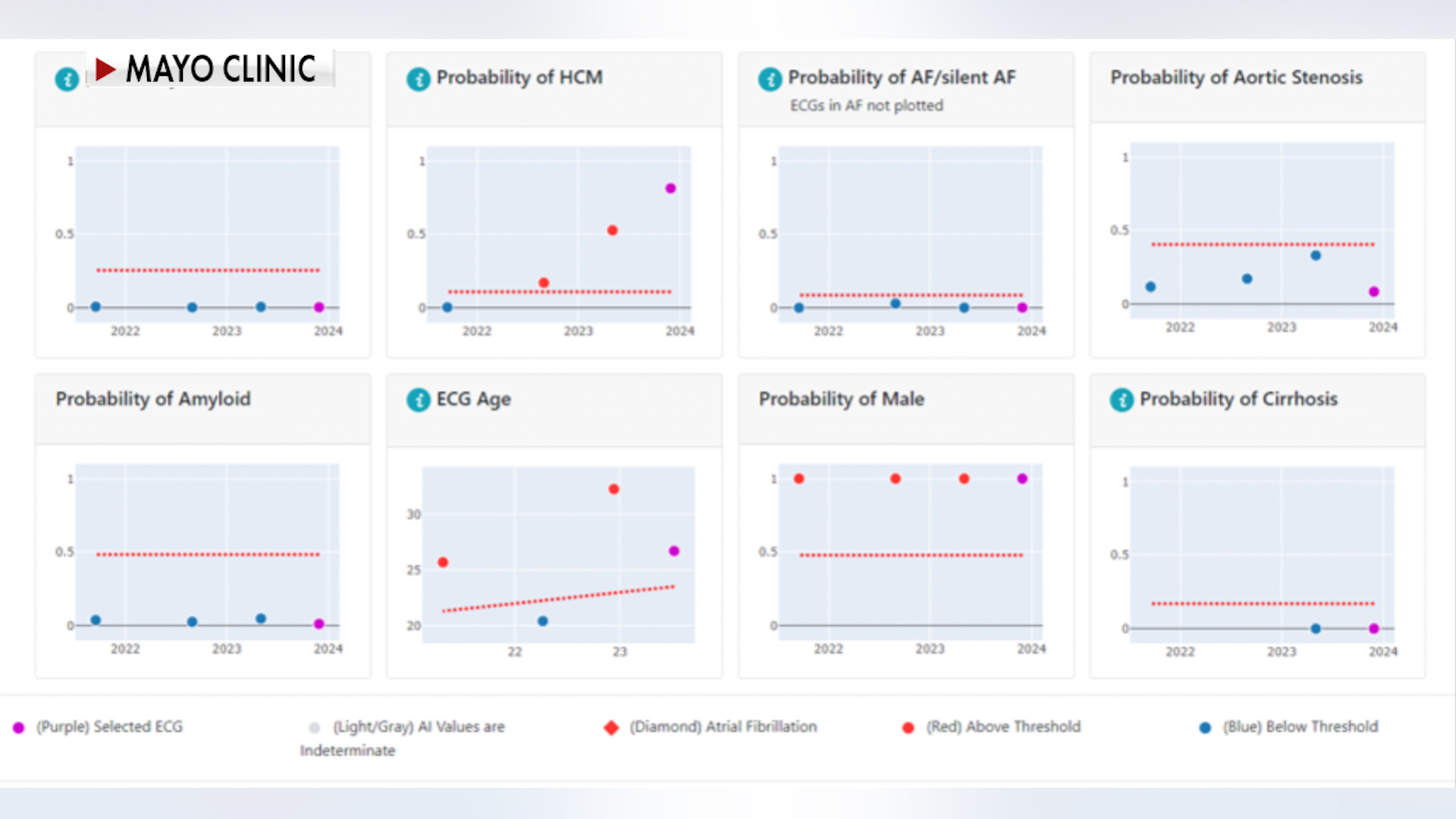
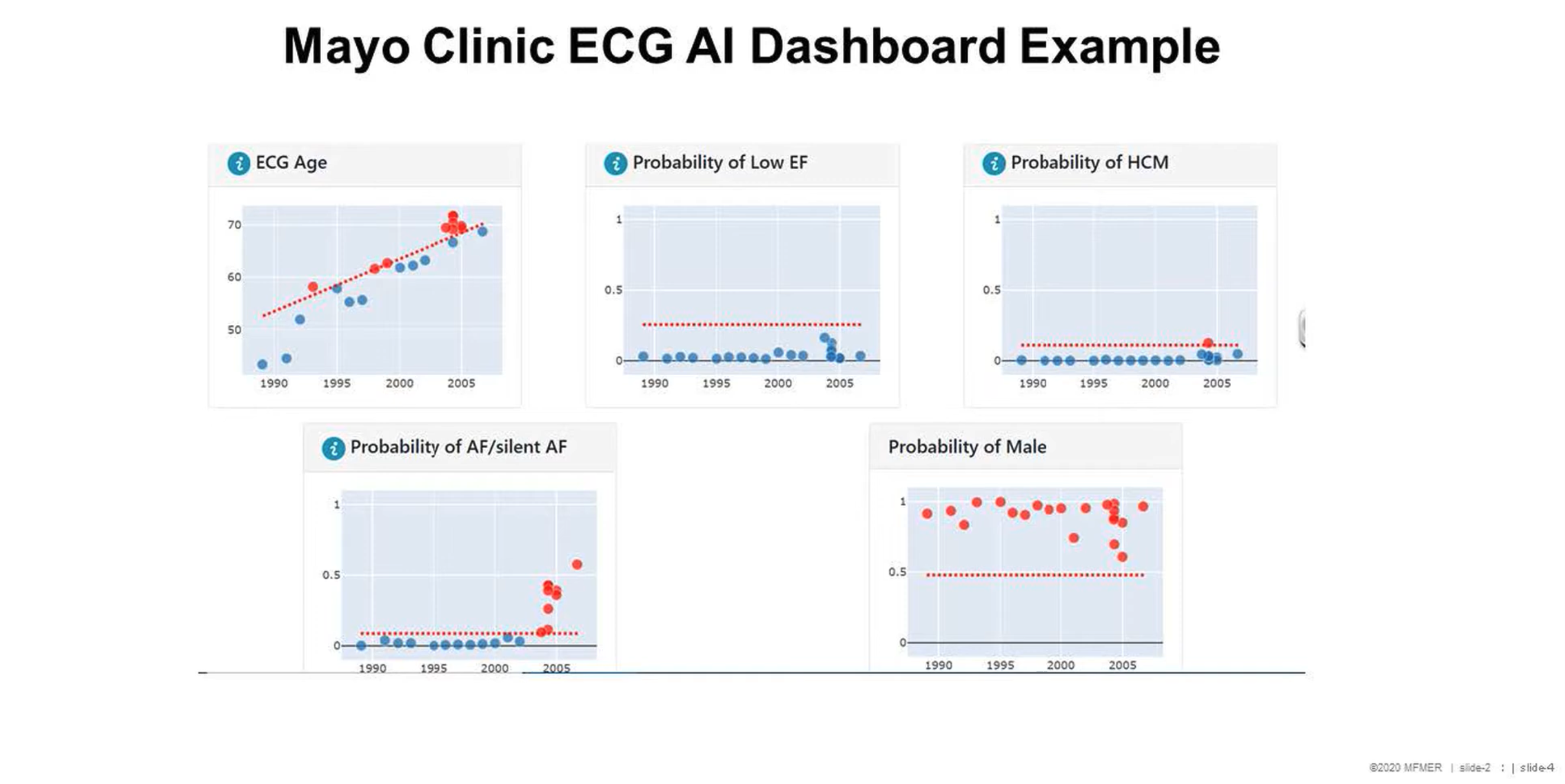 This screen grab from 3 shows the Mayo AI dashboard, which includes separate readouts for multiple different parameters. Amyloidosis risk is one of those parameters, although it is not shown in this example. (The amyloidosis readout is shown, however, in 4.) This dashboard shows five readouts for one patient, and shows how probabilities and calculations have changed for that patient over several years.It is inconceivable that Mayo reported only the "cardiac age" calculation to the White House. Why? Because that is a completely useless result! Age cannot be changed. There is no pill or treatment for the heart that is given simply because of the patient's age. The only reason to get the Mayo AI-EKG is to get one (or more) of the other dashboard readouts.
Test results perhaps concealed in the May 2026 report
- Exercise tolerance test This test may or may not have been performed. It is a standard part of an executive physical, and Trump has had it before as president (in 2018). We know he was having cardiovascular issues in 2025-2026, based on the uncommon tests that were performed, so performing an exercise tolerance test would have been quite informative. However, depending on the severity of the president's symptoms and his steadiness on his feet, it might not have been wise to put the president on a treadmill. A stationary bicycle can alternatively be used to measure exercise tolerance. Given his doctors' uncertainty about Trump's cardiovascular system (recall that he underwent coronary angiography, pulmonary angiography, and almost a cardiac MRI, supposedly "to definitively rule out any cardiovascular issues" 2), an exercise test would have been highly informative. And even if it was unnecessary to make the diagnosis, quantified exercise tolerance can be followed over time to gauge the value of different treatments.
Odd omissions in the May 2026 report
- Neurological symmetry Nowhere does the neurological exam use the word "symmetric." This has only a tenuous relationship with amyloidosis.
Summary
Collectively, normal or benign results from these tests and assessments could have all but squashed the suspicion of amyloidosis before it got started. Their absence is hard to explain. The most likely explanation to be offered by the president's physician is that there is a long precedent of selecting only some data to release publicly because otherwise the amount of data would be overwhelming. This is certainly true, which is why the first section of this page lists results that have appeared in past medical reports but which do not appear in the May 2026 report. The other possible objection from the president's physician is that the patient did not consent to the release of additional information. That position has several problems.
Cited Sources
- Diamond, Dan. The hair-loss drug Trump took for years is now absent from his medical records. Washington Post. June 4, 2026. Available on the web at: https://www.washingtonpost.com/politics/2026/06/04/trump-took-hair-loss-drug-years-its-no-longer-his-medical-records/
a The White House response does not appear to have been released publicly. Searches on 2026-09-13 failed to find record of it anywhere except in this Post article.
- Linskey A, Dawsey J, McGraw M. As Signs of Aging Emerge, Trump Responds With Defiance. Wall Street Journal. Jan. 1, 2026. Available on the web at: https://www.wsj.com/us-news/as-signs-of-aging-emerge-trump-responds-with-defiance-769c5dcd
- Grogan, Martha. Artificial Intelligence-Enhanced Electrocardiogram for Early Detection of Cardiac Amyloidosis. (Published Nov. 1, 2021. Downloaded on 2026-09-11.) Available on the web: https://www.mayoclinicproceedings.org/do-content/artificial-intelligence-enhanced-electrocardiogram-early-detection-cardiac-amyloidosis
- Hayes, Mills. Doctors say AI is a "game-changer" for number 1 killer of Americans. (Published Dec. 9, 2023. Downloaded on 2026-09-11.) Available on the web: https://www.foxbusiness.com/healthcare/doctors-say-ai-game-changer-number-1-killer-americans
Comment: The image is at: https://static.foxbusiness.com/foxbusiness.com/content/uploads/2023/12/mayp2.jpg
George Washington · John Adams · Thomas Jefferson · James Madison · James Monroe · John Q. Adams · Andrew Jackson · Martin van Buren · William Harrison · John Tyler · James Polk · Zachary Taylor · Millard Fillmore · Franklin Pierce · James Buchanan · Abraham Lincoln · Andrew Johnson · Ulysses Grant · Rutherford Hayes · James Garfield · Chester Arthur · Grover Cleveland · Benjamin Harrison · Grover Cleveland · William McKinley · Theodore Roosevelt · William Taft · Woodrow Wilson · Warren Harding · Calvin Coolidge · Herbert Hoover · Franklin Roosevelt · Harry Truman · Dwight Eisenhower · John Kennedy · Lyndon Johnson · Richard Nixon · Gerald Ford · Jimmy Carter · Ronald Reagan · George Bush · William Clinton · George W. Bush · Barack Obama · Donald Trump.45 · Joseph Biden · Donald Trump.47