
47⬅ Donald Trump: Anemia

Quicklinks

Chronic anemiaMORE
Unrecognized by the press, Trump has a poorly treatable chronic anemia,
apparent since May 2026
SEE BELOW.
(It is "poorly treatable" because it has not been successfully treated!)
Through Sep. 2026, the anemia has not been acknowledged in any way by the president's medical
reports. In fact, it can be hypothesized that the president's reports were
engineered to draw attention away from the anemia.
MORE
The cause of the anemia is unknown. It is not simple aging.
Anemia can occur as a complications of systemic amyloidosis.
Iron deficiency (a cause of anemia) is common in both heart faiure and cardiac amyloidosis
1.
More...
Introduction
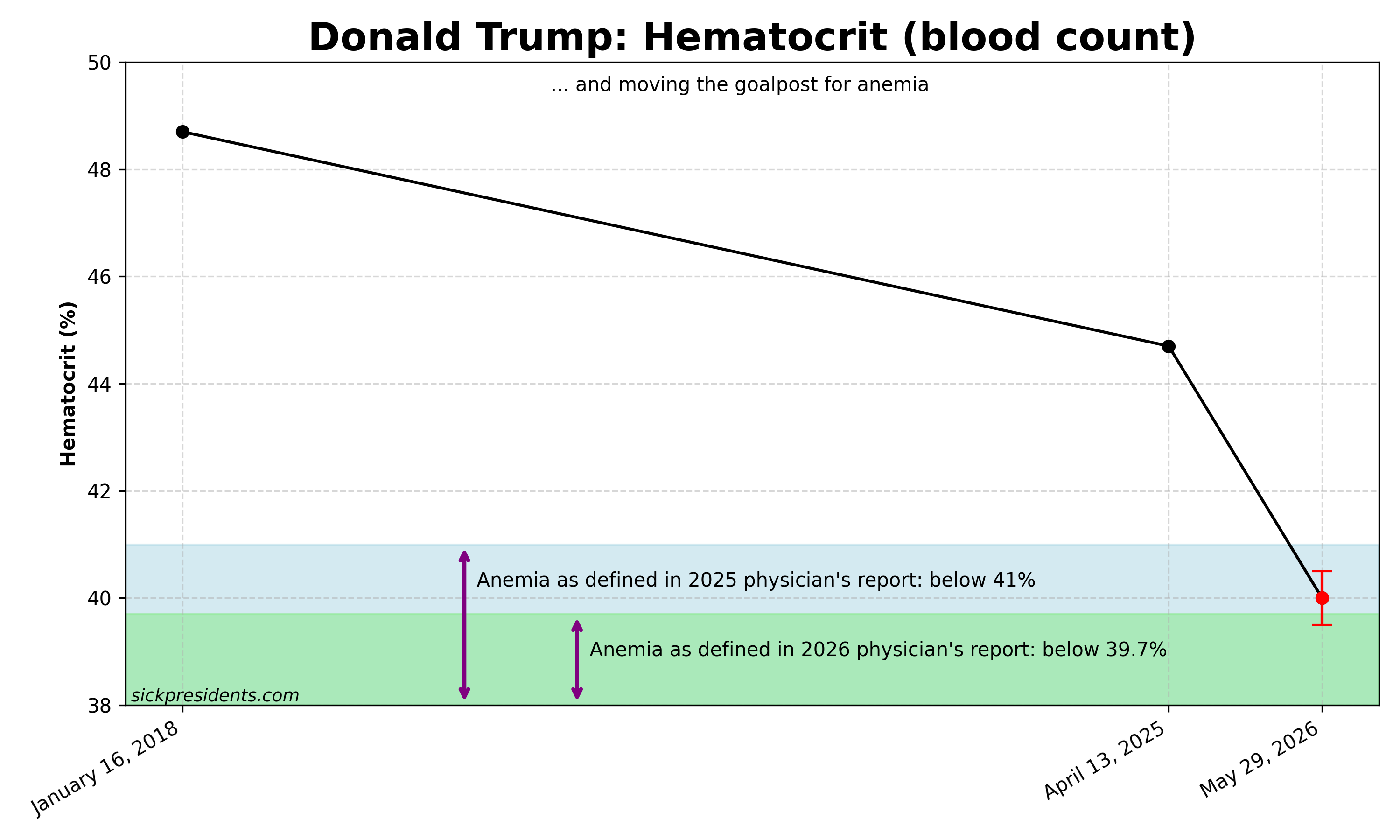
The graph below shows how President Trump's blood count ("hematocrit") has changed in recent years.The rest of this post provides the support for these conclusions. It is written in considerable detail, to convince skeptics that no exaggeration has been applied. Specifically, see the justification for calling it "anemia" instead of "borderline anemia" or "relative anemia" or "dropping red cell mass." The graph's comments about moving the goalposts for anemia are discussed elsewhere MORE.
- The president has a chronic anemia that is not easily treatable.
- The anemia has not been recognized publicly by the administration.
- Having not been acknowledged, its cause has not been disclosed.
- Anemia has an almost uncountable number of possible causes, so, although his low blood count tells us the president is chronically ill, in the absence of a disclosed cause the anemia doesn't tell us WHAT is making him sick.
- These are not speculations. They should be treated as fact.
Basic observations
From the graph above, we can make two basic medical observations:Why do these observations matter?
- The president's blood counts ("hematocrit") have markedly declined from 2018 to 2026,
- The president's blood count has significantly declined over the past year.
- The observations come from the White House, and no other source but the White House,
- The observations lead to important conclusions about the president's health and medical candor.
Medical conclusions
- On an absolute scale, his blood count now sits at the anemia borderline.
- Compared to his pre-2019 baseline, however, it is certain that he has a "relative anemia," as described in the appendix, below. It's the obvious large change that's most worrisome, not the absolute level.
The 2018 hematocrit of 48.7% could have been pathologically high, and the decline afterwards could represent treatment of the condition causing the high reading, e.g. sleep apnea. Response: This point is granted, and I am embarrassed that I missed it. In defense, I say that it represents yet another example of how the printed normal ranges in the medical reports have an outsize effect on the public's view of the results. I would also say that it does not change the fundamentals of the analysis on this page. The 2025 reading was not pathological, and the drop into 2026 was significant and merits full medical attention.- For reasons detailed in the appendix, it is nevertheless proper to say the president has anemia, without modifiers. It would recklessly endanger him to say he has "borderline anemia" or "relative anemia."
- Because his anemia has developed over a period of years, it is "chronic anemia."
- Chronic anemia is 100% proof that Trump is chronically ill. The drop in the his blood counts are NOT normal healthy aging. And even if one recklessly refuses to acknowledge the president's anemia, the years-long dropping blood counts are themselves 100% proof of a chronic illness.
Medical implications
Anemia is too often dismissed as a minor medical matter, but in a man it is always cause for concern. The list of possible causes is enormous, but the first thought in an 80-year-old is always bleeding into the gut. The blood mixes with stool and is excreted from the body, thereby causing anemia. In persons who have a bleeding or bruising tendency elsewhere in the body, the concern for bleeding into the gut is magnified, and so it should be with Donald Trump. As detailed in the sections below, the president's medical reports contain very little information to help us understand the cause of the anemia. The most helpful information is the fact that the blood counts have not only been dropping for years, but that the blood counts have been ALLOWED to drop for years. This continued drop is a clear sign that the president's anemia is not easily treatable, because of course his physician would have treated the anemia if the treatment were simple, safe, and effective. Anemia can make people feel miserable with fatigue and breathlessness, so physicians treat it when they discover it... if they can. Perhaps the president's physicians would attempt to explain by saying, "The president has only a borderline anemia and he doesn't have any bothersome symptoms from it, so there is no point in treating it." That would be wrong. The president cannot stay awake at his desk! True, no one can say with 100% certainty whether the anemia is or is not contributing to the president's drowsiness, but the drowsiness is obviously not responding to whatever treatments the doctors are trying, so any doctor worth a fig would jump at the chance to apply a simple anemia treatment in the hopes of improving the drowsiness... if the anemia were easy to treat. Thus, the fact that the dropping blood counts have been allowed to go on is a clear sign that the president's anemia is not easily treatable. Anemias can be complicated to treat, dangerous to treat, or have no effective treatment. It depends on the specific cause, and in the president's case we don't know what that specific cause is. The president's doctors are not stupid and they are not incompetent. They know what is going on. They just haven't told us. In fact, there's quite a bit they haven't told us, as the following sections discuss.
What haven't the doctors told us? — #1: the MCV
The first step in tracking down the cause of anemia is a blood measurement called the MCV (mean corpuscular volume — the average size of each red blood cell). Because the MCV can be especially revealing if inapparent bleeding is causing the anemia, it is a very important number in anyone who has anemia. The MCV is not mentioned in any of the president's medical reports, but because hematology lab machines always run the MCV along with the hematocrit, we can be sure the MCV was measured every time. Before 2026 the MCV might not have been considered important enough to report to the public. But in 2026 that clearly changed. It is now a very important test for the president... and it has been withheld. There are only three possible reasons to explain the concealment:The conclusion is dispiriting, because it strongly suggests a deliberate effort to mislead the public.
- 1) The president's physician does not realized how important the MCV is.
- No. This explanation is untenable because it requires that the president's physician is stupid or careless, and that his hematology consultant (there surely was a hematology consultant) is also stupid or careless. I believe neither is true. In fact, it is apparent that the president's physician is 100% aware of the trend in the president's blood counts MORE, which means he is 100% aware of the MCV's importance.
- 2) The president's physician is aware of the MCV's importance, but he and/or the president has decided that the American public (including the vice president!) need not know it.
- No. The key phrase here is "need not know," as opposed to "should not know" or even "must not know." This explanation does not hold because it breaks the pledge to release information "materially affecting his health status" 2. There can be no question that anemia materially affects health.
- Some may object that putting the MCV into the report would necessitate adding a raft of context and explanation that would undesirably inflate the size and complexity of the report. Of course it would, but withholding the informaation would be a ridiculous decision, akin to a physician saying "I'm sorry Mr. Jones, you have cancer, but telling you which organ has the cancer or whether the cancer is treatable is just too complicated for you and is not worth my time, plus I don't want to answer all the questions you would ask. Have a nice day." No physician thinks that way.
- 3) The president's physician is aware of the MCV's importance, but he and/or the president has decided that the American public (including the vice president!) should not know it.
- Yes. The key phrase here is "should not know," which is the same as "should not be allowed to know" or "cannot be allowed to know." This is the only explanation that makes sense.
What haven't the doctors told us? — #2: the rest
Once a physician has decided that a patient has anemia, and has measured the MCV, additional tests are invariably performed. Some of the following tests may be skipped once the cause of the anemia becomes clear, but in many cases, particularly in older people, test after test is inconclusive. The list of tests below is not the full list of tests that could be performed, but they are the "mainstream" tests. The few already measured in the president are labelled "done."Clearly the president's medical reports have been far less than forthcoming. Granted, the physician does not want to lay bare the entire evaluation of the president's medical problem. It is possible, however, to summarize the evaluation in a way that gives confidence to the public that the evaluation has been thorough (for the president's sake) and that nothing is being withheld, for example: "Studies for bleeding, nutritional disorders, hemolysis, hypo-proliferation, kidney and liver disease, and toxic disease were normal. The leading diagnosis is [whatever]. We have elected not to treat at this time, and will continue to follow blood studies."
- Blood smear
- Blood reticulocyte count
- Blood levels of vitamin B12 (done), thyroid (done), folate, homocysteine, MMA, testosterone
- Blood iron studies such as ferritin, TIBC, serum iron
- Blood studies of kidney function (partially done) and liver function (partially done)
- Colonoscopy (done), upper GI endoscopy, and stool blood checks to look for bleeding
- Blood and urine tests for signs that red blood cells are breaking apart ("hemolysis")
- Bone marrow aspirate and/or biopsy
- Protein electrophoresis to rule out multiple myeloma
- Trace metals in blood (for difficult cases)
- Sophisticated studies to check for dilutional anemia, given his anasarca
Appendix: Why call this "anemia" instead of "borderline anemia"?
Anemia is the condition of having too few red blood cells (red cell mass, really). The "hematocrit" is the most common test to check for anemia, though others exist. When the hematocrit value is below the normal range, the patient is said to be anemic. The normal range for hematocrit (and the other measures) varies from laboratory to laboratory, but in practice that is not a major issue because (a) the variance is usually small, and (b) it is better to use the patient as their own "normal value," and watch for deviations from their baseline. When a patient's hematocrit drops substantially from their normal baseline, we can call that "relative anemia," even if the patient's hematocrit remains in the normal range. However, because many people are obsessed with what is defined as "normal" for the population, the rest of this discussion will speak of the criteria for anemia that rely on absolute numbers for the normal range, rather than the patient's baseline numbers. Whenever a blood count is in the anemia borderline zone, a doctor has to decide how to react to it. The doctor can treat it:Every reasonable physician in the world would pick (c) for President Trump because of the large drop that has occurred in his blood count. In other words, his marked relative anemia forces us to treat his borderline anemia as if it were certainly an anemia.
- (a) like a normal result that needs no more work,
- (b) like an uncertain result that should be checked again later to see if the picture gets clearer, or
- (c) like an abnormal result that starts a hunt for a disease that causes anemia.
Supporting this, the Merck Manual notes that symptoms of anemia "usually develop when the hemoglobin level falls well below the patient's individual baseline." It adds: "Symptoms are generally more pronounced in patients with limited cardiopulmonary reserve" 3. That would describe Trump if he had heart failure.Choice (b) is not a reasonable choice because the blood count trend is already clear. Re-testing serves no purpose unless we suspect there has been an error in the test or some large clinical change. Re-test harms the patient because it delays the search for the cause of the anemia, and therefore delays treatment, which is a harm to the patient. Choice (a) is a really bad choice, because it leaves the marked relative anemia unexplained. If a physician took this path and the patient was later found to have a disease that causes anemia, the physician would be an attractive target for a malpractice attorney, and with good cause! Taking this course is risky for both the patient and the physician. Clinically, therefore, we should accept that his borderline blood count is in fact anemia on an absolute scale. It serves no purpose to harp on the exact number, especially because the exact number is not exact at all! (Because it was rounded MORE.)
Cited Sources
- Jobbé-Duval A, et al. Prevalence and determinants of iron deficiency in cardiac amyloidosis. ESC Heart Failure. 2022; 9: 1314-1327. Available on the web at: https://doi.org/10.1002/ehf2.13818
- Diamond, Dan. The hair-loss drug Trump took for years is now absent from his medical records. Washington Post. June 4, 2026. Available on the web at: https://www.washingtonpost.com/politics/2026/06/04/trump-took-hair-loss-drug-years-its-no-longer-his-medical-records/
- Gerber, Gloria F.; Emadi, Ashkan. Evaluation of anemia. (Published Sep. 2024. Downloaded on 2026-09-16.) Available on the web: https://www.merckmanuals.com/professional/hematology/approach-to-the-patient-with-anemia/evaluation-of-anemia
George Washington · John Adams · Thomas Jefferson · James Madison · James Monroe · John Q. Adams · Andrew Jackson · Martin van Buren · William Harrison · John Tyler · James Polk · Zachary Taylor · Millard Fillmore · Franklin Pierce · James Buchanan · Abraham Lincoln · Andrew Johnson · Ulysses Grant · Rutherford Hayes · James Garfield · Chester Arthur · Grover Cleveland · Benjamin Harrison · Grover Cleveland · William McKinley · Theodore Roosevelt · William Taft · Woodrow Wilson · Warren Harding · Calvin Coolidge · Herbert Hoover · Franklin Roosevelt · Harry Truman · Dwight Eisenhower · John Kennedy · Lyndon Johnson · Richard Nixon · Gerald Ford · Jimmy Carter · Ronald Reagan · George Bush · William Clinton · George W. Bush · Barack Obama · Donald Trump.45 · Joseph Biden · Donald Trump.47