






Systemic amyloidosis
Matters before 2021 are covered on the
Trump.45 page.
Donald Trump's second term has been dominated by an obvious physical decline 1 that administration officials have steadfastly ignored, even as equally steadfast allies publicly fear for his health 2. At age 80, hard data in Trump's most recent medical report point to a disease called systemic amyloidosis:
Donald Trump's second term has been dominated by an obvious physical decline 1 that administration officials have steadfastly ignored, even as equally steadfast allies publicly fear for his health 2. At age 80, hard data in Trump's most recent medical report point to a disease called systemic amyloidosis:
- His blood pressure is 105/71, down 20 points (in the top number) from his lifelong excellent readings.
- His ankles are chronically and untreatably swollen ("edematous").
- His heart squeezes well, when seen on cardiac ultrasound.
More...
Trump's mother has multi-generational roots on the Isle of Lewis
MORE,
which is the largest of the Hebrides islands, 24 miles out to sea from Scotland.
This is medically relevant for her son, Donald Trump, though speculative.
I should say, highly speculative. But it has been an enjoyable
experience to learn about this part of the world.
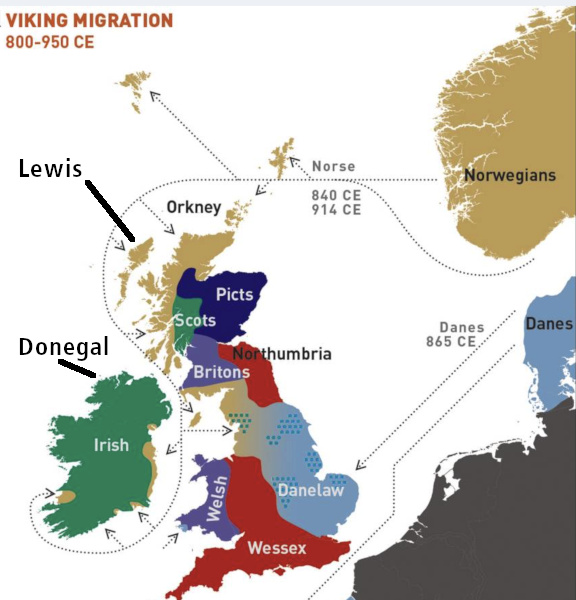 Trump's mother is solidly part of a genetic island as well as a geographic island.
(See map, slightly altered from
3.)
DNA studies of Hebrideans confirm exactly what
geography would have us suspect: they are "genetically distinct
from the rest of mainland Scotland" and this "isolation suggests a small,
isolated, ancestral island population differentiated by isolation by distance"
4.
Furthermore, the Hebrideans' closest genetic
relatives are, first, the northern Scots (of course) and, second, the Irish,
especially those in County Donegal
4.
Gemini offered two other interesting facts:
Isle of Lewis / The Hebrides
Trump's mother is solidly part of a genetic island as well as a geographic island.
(See map, slightly altered from
3.)
DNA studies of Hebrideans confirm exactly what
geography would have us suspect: they are "genetically distinct
from the rest of mainland Scotland" and this "isolation suggests a small,
isolated, ancestral island population differentiated by isolation by distance"
4.
Furthermore, the Hebrideans' closest genetic
relatives are, first, the northern Scots (of course) and, second, the Irish,
especially those in County Donegal
4.
A Lewis island genealogist notes that the island was part of Norway
until the 1300s and that Viking ancestry is common among islanders
5.
That may be so, but DNA shows that the Hebrideans are less than 10% Viking-blooded
4a,
while islands north of Scotland — the Orkneys and Shetlands — are
up to 25% Viking
3
4.
Population DNA studies are remarkable in their ability to reveal history.
DNA from the northern islands shows that the Viking blood was admixed about
29 generations ago over a relatively short period of time
3,
which fits with the historically known expansion of the Vikings about the year 900.
Donegal Genes
Two genetic diseases are unusually common in natives of County Donegal: hemochromatosis and... systemic amyloidosis. Both of these diseases produce restrictive cardiomyopathies, as Donald Trump appears to have. MORE The version of amyloidosis in County Donegal is common enough to have a slang name among the population: "Donegal Amy" 6. It arises from a specific variation in the "TTR" gene that was originally carried by a single individual far in the past, but has since spread widely, now carried by up to 1.1% of the local population 7 — very high for a genetic disease caused when just one copy of the gene is a variant.
A finger has been pointed at a man named Conall Gulban, born circa 400 AD
7,
as the remote ancestor (or one of his descendants was).
Genealogies reaching this far back are going to be
unreliable, however. In principle, DNA studies could estimate how long
ago the variant entered the population, but no such studies have been reported.
We won't say much about hemochromatosis, a disease in which iron accumulates
in tissues, leading
to diabetes and heart failure. Although it can escape detection for decades,
it is nowhere near as obscure as amyloidosis. The discussion of Trump's anemia
does mention it, however
MORE.
Therefore, the question arises: Could Donald Trump have Donegal Amy?
It is a reasonable question.
In one of the seeming inconsistencies of
clinical medicine, the odds would appear to be remote, but if Trump did happen
to turn up with Donegal Amy, physicians everywhere would say "Ah, yes, of course" ...
because the explanation for an uncommon disease must, perforce, be something
uncommon.
For Trump to have Donegal Amy, the following conditions must be true:
- Genes from the Donegal population got to the Lewis Isle population hundreds of years ago.
- Donegal Amy, in Trump's family for generations, escaped recognition as a family ailment.
- Trump's illness matches the nuances of Donegal Amy.
Condition #1: Donegal genes get to Lewis
Rather than study 2000 years of regional history, I asked Google Gemini, "Is there genetic or other data to suggest that migrations from County Donegal to Lewis Harris Island have occurred at any point in time?" The short answer, certainly open to challenge, is that gene flow was significant from the years 500-1500, in three ways: "centuries of Norse-Gaelic intermarriage, warrior migrations (Gallowglass), and shared maritime networks across the Irish Sea."Click for transcript, part 1
Answer: Historical movement between Donegal and the Outer Hebrides occurred across several key eras:
- Early Medieval & Kingdom of the Isles (Dál Riata Era) — From the 6th century onward, the expansion of Gaelic language, monastic culture (such as St. Columba’s mission from Donegal/Derry to Iona), and maritime trade established the Sea of Moyle and the Minch as waterways connecting North-West Ulster directly to the Hebrides.
- The Norse-Gael Era (10th–13th Centuries) — During the Viking and post-Viking periods, the Western Isles (Lewis and Harris) and Northwest Ireland were part of an interconnected Norse-Gaelic maritime world. Clan links, intermarriage, and naval raiding/settlement led to continuous genetic exchange between coastal Donegal and the Hebridean islands.
- Gallowglass (Gallóglaigh) Mercenaries (13th–16th Centuries) — One of the most direct documented population transfers involved Gallowglass warrior families—hereditary elite mercenaries of mixed Norse-Gaelic origin from the Western Isles of Scotland (including Lewis and Harris)—who moved to Ulster and County Donegal to serve local chieftains like the O'Donnells and O meadhra/MacSweeneys. Over generations, many settled permanent branches in Donegal, leading to bidirectional familial ties.
- "The Irish language dialect spoken in Donegal (Gaeilge Dhún na nGall) shares distinct phonetic and grammatical features with Scottish Gaelic (Gàidhlig) spoken in Lewis and Harris, reflecting centuries of unbroken maritime contact."
- "Surnames common to both regions (such as MacLeod, MacSween/Sweeney, MacAulay, MacDonald, and Doherty/Dochartaigh variants) reflect intermarriage and movement between Ulster and the Hebrides."
Condition #2: Donegal Amy goes unseen
Trump has never spoken of a disease running in his family. Is it possible that his family — over many generations — failed to notice a disease as deadly as amyloidosis?Yes.
In fact, even in County Donegal, where likely 1% of the population had the gene for centuries, no one recognized the familial nature of the disease until the 1980s, well after Trump's mother was a senior citizen 8 9. The same was true for Donegal Amy that traveled to the United States 10.
This hard-to-believe delay in recognition stems from the nature of the disorder. Its symptoms come on slowly in old age, mimic old age in many ways, and sometimes do not come on at all. In medical-speak:The late onset of this disorder, together with the likely probability that the neuropathy and the possibility of amyloidosis are overlooked in some affected individuals, explains the seemingly sporadic nature of several patients with this dominantly inherited disorder. It is possible that some gene carriers never develop the disease, even in advanced age, as occurs in the Portuguese type of FAP [familial amyloid polyneuropathy]. 11
Condition #3: Trump fits Donegal Amy
Although a high suspicion is warranted that Trump has amyloidosis in general, we should now look to see how well he fits the Donegal Amy type. More than 150 different variants of the TTR gene are known to cause amyloidosis, but the symptoms of each type can differ. For example, the order of organ involvement can vary, the age at onset can vary, the aggressiveness of the disease can vary, and so on.
Medically, Donegal Amy has been called by a variety of names:
"Thr80Ala ATTR amyloidosis," "T80A ATTR amyloidosis,"
"Thr60Ala ATTR amyloidosis," "T60A ATTR amyloidosis,"
"Appalachian amyloidosis," and "Irish amyloidosis."
In a series of 24 patients with the disorder, studied from 2012-2022
the average age at diagnosis was 65, and a quarter were diagnosed past age 66.5
7.
This, however, was in northern Ireland, where physicians are attuned to the
disease. Delays could be much longer in the United States.
There are also
anecdotal
reports of Donegal Amy patients living well into their 80s.
In the series of 24,
neurological involvement, chiefly carpal tunnel syndrome, was a prominent and
early part of the disease, occurring an average of seven years
before the diagnosis was made. (Trump may or may not have had carpal tunnel surgery.
MORE)
Beyond this,
75% of the patients had clinical features of autonomic neuropathy,
including erectile dysfunction, head rush or fainting from standing up
("postural hypotension"),
diarrhea or constipation, nausea and vomiting, and/or weight loss.
Two-thirds had cardiac involvement, predominantly heart failure, by the time of diagnosis.
One may get the sense that, to match Donegal Amy, Trump's problems started too
late in life and that he lacks the autonomic features. No such conclusion can be
definite, however. In the series of 24 patients, "the
neuropathy was often overlooked." Moreover, five relatives who must have had the gene
died without developing symptoms
7
(in medical-speak, the "penetrance" of the disease is less than 100%).
Hence, there is room for Trump to be carrying the gene... but it seems dubious
for two reasons: (1) The thin information about his medical history
prevents firm conclusions about the degree to which he matches the typical
features of Donegal Amy, and
(2) The longevity of Trump's maternal ancestors is a major strike against Donegal Amy.
But never say never. Putting 100% faith in a genealogy is always unwise
12.
Conclusions
Academically, it would be very interesting to know whether the TTR gene was sequenced in the subjects from the Hebrides in the 2019 Scottish gene study 4. It seems, however, a stretch to say that Trump meets condition #3 and that we can posit he has Donegal Amy. Still, if he does prove to have amyloidosis, sequencing his TTR gene will be an important step in managing his disease, because, if a non-normal variant is found, his blood relatives would need to be checked for the same variant and possibly started on medication.
More about Donegal Amy:
· https://www.youtube.com/watch?v=5mWCxhTqfLM
· https://www.wired.com/story/crispr-treatment-donegal-amy/
· https://www.youtube.com/watch?v=5mWCxhTqfLM
· https://www.wired.com/story/crispr-treatment-donegal-amy/
Cited Sources
- Reiner, Jonathan. I Was Dick Cheney's Cardiologist. Trump Has Not Looked Well, and We Should Know Why. New York Times. Aug. 12, 2026. Available on the web at: https://www.nytimes.com/2026/08/12/opinion/trump-health-questions.html
- Chavez, Paloma. Bill O'Reilly Urges Trump, 80, to Take a Month Off for His Wellbeing: "You Need a Breather". People. July 23, 2026. Available on the web at: https://people.com/bill-oreilly-urges-trump-take-month-off-12025441
Comment: O'Reilly's comment is startling in its similarity to the Chicago Tribune's editorial of March 22, 1865, which said of a "worn and weakened" Abraham Lincoln: "He needs a least a month's entire rest from his official duties." (See The Physical Lincoln Complete, pp 105, 387-388.) Lincoln was then in the advanced stages of cancer, as discussed in The Physical Lincoln. - Leslie S, et al. The fine scale genetic structure of the British population. Nature. 2015 March 19; 519(7543): 309-314. DOI: 10.1038/nature14230
Comment: Free full text at: https://pmc.ncbi.nlm.nih.gov/articles/PMC4632200/ - Gilbert E, et al. The Genetic Landscape of Scotland and the Isles. Proceedings of the National Academy of Sciences. 2019: 116 (38) 19064-19070. DOI: 10.1073/pnas.1904761116
a Datasets S2 and S3
- Geoghegan, Peter. The Tiny Scottish Village That Spawned Trump. (Published May 11, 2016. Downloaded on 2026-09-27.) Available on the web: https://www.politico.com/magazine/story/2016/05/donald-trump-scottish-village-scotland-mother-213882/
- Callaghan, Rosaline. Not Rare to Us: A Family Story of "Donegal Amy". Journal of Cardiac Failure. 2026; 32(5): 962-963. DOI: 10.1016/j.cardfail.2026.02.036
- Hewitt K, et al. Spectrum of hereditary transthyretin amyloidosis due to T60A (p. Thr80Ala) variant in an Irish Amyloidosis Network. Open Heart. 2024; 11: e002906. DOI: 10.1136/openhrt-2024-002906
- Dervan P, Kelly P, Staunton H. Amyloid Neuropathy — A Cluster of Five Cases [Abstract]. Canadian Journal of the Neurological Sciences. 1983; 10(2): 140.. DOI: 10.1017/S0317167100044784
- Staunton H, et al. Hereditary amyloid polyneuropathy in north west Ireland. Brain. 1987; 110: 1231-1245. DOI: 10.1093/brain/110.5.1231
- Benson MD, et al. Hereditary amyloidosis: Description of a new American kindred with late onset cardiomyopathy: Appalachian amyloid. Arthritis and Rheumatism. 1987; 30(2): 195-200. DOI: 10.1002/art.1780300210
- Staunton H, et al. Irish (Donegal) amyloidosis is associated with the transthyretinALA 60 (Appalachian) variant. Brain. 1991; 114: 2675-2679. DOI: 10.1093/brain/114.6.2675
- Bellis MA, et al. Measuring paternal discrepancy and its public health consequences. Journal of Epidemiology Community Health. 2005; 59: 749-754. DOI: 10.1136/jech.2005.036517 Also available on the web at: https://pmc.ncbi.nlm.nih.gov/articles/PMC1733152/
George Washington · John Adams · Thomas Jefferson · James Madison · James Monroe · John Q. Adams · Andrew Jackson · Martin van Buren · William Harrison · John Tyler · James Polk · Zachary Taylor · Millard Fillmore · Franklin Pierce · James Buchanan · Abraham Lincoln · Andrew Johnson · Ulysses Grant · Rutherford Hayes · James Garfield · Chester Arthur · Grover Cleveland · Benjamin Harrison · Grover Cleveland · William McKinley · Theodore Roosevelt · William Taft · Woodrow Wilson · Warren Harding · Calvin Coolidge · Herbert Hoover · Franklin Roosevelt · Harry Truman · Dwight Eisenhower · John Kennedy · Lyndon Johnson · Richard Nixon · Gerald Ford · Jimmy Carter · Ronald Reagan · George Bush · William Clinton · George W. Bush · Barack Obama · Donald Trump.45 · Joseph Biden · Donald Trump.47