
27⬅ William Howard Taft: His Appetite

severe obesity
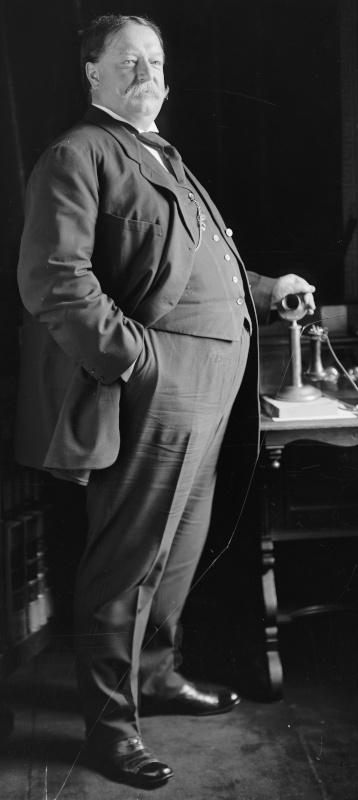
The troubles of William Howard Taft, however, were not the usual presidential woes that became familiar to me. One of Mr. Taft's troubles was food. He loved it, and the more food he could get, the more he loved it. The rub was that after he moved into the White House, his doctor and Mrs. Taft were constantly on the alert to enforce a diet that would get rid of some of his surplus poundage. Mrs. Taft might be reasonably described as a strong-minded woman. She took dieting seriously -- for the President -- and this led to a lot of talk that in a less famous household might have been called nagging.The President dieted, all right, but not when he could escape supervision. I remember once when I accompanied him on a journey to Ohio. When we got on the train, leaving the doctor and Mrs. Taft behind, the President began to perk up. He also apparently began to think about food, although it was ten o'clock in the evening. Wilbur Hinman, a stenographer, and I were in the observation section of Mr. Taft's special car going through telegrams and letters when the President appeared at the door of his sitting room. A pleasant smile turned the corners of his mouth. I took one look and knew what was on his mind.
"Anybody seen the conductor?" he asked.
The conductor came a-running.
"The dining car..." Mr. Taft began shyly. "Could we get a snack?"
The conductor looked surprised. "Why, Mr. President, there isn't any dining car on this train."
The President's sun-tanned face turned pink, with perhaps a few splashes of purple. His normally prominent eyes seemed to bulge.
"Norton!" he called in a cold voice. "Mr. Norton!"
Charles D. Norton, a tall, good-looking, and well-dressed man, appeared from the next compartment. He was Mr. Taft's secretary, and he probably had been given special instructions by Mrs. Taft in regard to the President's diet on the trip.
"Mr. Norton," the President said, "there is no diner on this train."
Norton agreed that there was no diner. He reminded Mr. Taft that they had had dinner at the White House, and assured him that they would not go without breakfast. He recalled that the President's doctor had warned him about eating between meals. The President brushed him aside, turning back to the conductor.
"Where's the next stop, dammit?" he asked. "The next stop where there's a diner?"
The conductor believed it would be Harrisburg. Mr. Taft glared at Norton and addressed the conductor:
"I am President of the United States, and I want a diner attached to this train at Harrisburg. I want it well stocked with with food, including filet mignon. You will see that we get a diner." He silenced the secretary's protests with a roar. "What's the use of being President," he demanded, "if you can't have a train with a diner on it?"
Norton gave up. The diner was attached at Harrisburg in the middle of the night, and the President had the newspapermen advised that it was open to them. He sat in his own car for a long time, partaking of refreshments. He seemed to be in high good humor. Personally, I applauded him for his humanness in kicking over the traces when he had the opportunity.
The problem of food harassed Mr. Taft throughout his administration, and I always felt that it added considerably to his unhappiness with the high office he occupied. But it was only one of his woes. He could have doubled Harry Truman in spades when the Missourian once remarked that he hadn't ever wanted to be President.
- Bumgarner, John R. The Health of the Presidents: The 41 United States Presidents Through 1993 from a Physician's Point of View. Jefferson, NC: MacFarland & Company, 1994. ISBN: 9780899509563. [Buy]
 a p.167

Comment: Devotes one chapter to each President, through Clinton. Written for the layperson, well-referenced, with areas of speculation clearly identified, Dr. Zebra depends heavily on this book. Dr. Bumgarner survived the Bataan Death March and has written an unforgettable book casting a physician's eye on that experience. - Hicks, F. C. William Howard Taft, Yale Professor of Law & New Haven Citizen. New Haven, CT: Yale University Press, 1945.
- Levine, DI. Corpulence and correspondence: President William H. Taft and the medical management of obesity. Annals of Internal Medicine. 2013; 159: 565-570. DOI: https://doi.org/10.7326/0003-4819-159-8-201310150-00012
Comment: This error-filled article should be ignored. - Sotos, JG. Corpulence and correspondence. Annals of Internal Medicine. 2014; 160: 580. DOI: https://doi.org/10.7326/L14-5008
Comment: Refutes the unfortunate Levine article. - Smith, Ira R. T.; Morris, Joe Alex. "Dear Mr. President:" The Story of Fifty Years in the White House Mail Room. New York: Julian Messner, 1949.
a pp.66-69
Comment: Ira Smith was a peppery fellow who ran the White House mail room from 1897 to 1948. He started working during the administration of William McKinley and was the only mail room staffer until the volume of mail made it necessary to hire help during the administration of Franklin Roosevelt.